What Is an Invitation to Play? A Complete Guide for Busy Moms (Inspired by Montessori and Reggio Emilia)
I use the phrase “invitation to play” all the time. I first heard it in one of my kiddo’s Montessori classrooms and it really stuck. Now I use it whenever I am setting up activities for my own kids or sharing ideas with other moms or educators (or both, because there is a lot of overlap in this corner of the internet).
If you have ever scrolled past a beautifully arranged tray of acorns, a tiny bowl of water, and a paintbrush on Instagram and thought, “That looks lovely, but how on earth do I do that without losing my mind?”, this guide is for you. An invitation to play is one of the simplest, most generous things you can offer a child. It does not require a perfect Pinterest shelf, a degree in early childhood education, or a budget. It just requires noticing what your kid is curious about and giving them space to follow that curiosity.
Today I am going to walk you through exactly what an invitation to play is, where the idea came from, why it works (with a little nerdy research mixed in), and how to set one up in your own home this week. I am pulling from both Montessori and Reggio Emilia because they complement each other beautifully. By the end you will have everything you need to set one up tonight with materials you already own.
What Is an Invitation to Play?
In simple terms, an invitation to play is a thoughtful arrangement of open ended materials that gently calls your child to explore. Think of it as a quiet little hello from the environment itself. No instructions. No worksheet. No “right” outcome. Just a small, beautiful setup waiting to be discovered.
A few things make an invitation to play different from a “regular” activity:
It is child led. The adult sets the stage and then steps back. The child decides what to do, how long to do it, and when they are finished. There is no end product the adult is steering toward.
It is open ended. The materials can be used in dozens of ways. A bowl of pinecones, a piece of felt, and a spoon can become sorting practice, a pretend forest, a counting game, or a tea party for stuffed animals. Whatever the child brings to it, the materials can hold.
It is beautifully presented. This is the part that surprises a lot of parents. The way you arrange the materials matters. Not because kids need to live in a magazine, but because a clean, intentional setup signals “this is for you, and it is worth your attention.” You will see the difference the first time you try it.
That is the whole concept. Now let me show you where this idea actually comes from, because the history makes the practice click.
Where the Idea Comes From: Montessori and Reggio Emilia
The phrase “invitation to play” lives at the intersection of two early childhood philosophies that have shaped how educators think about young learners for over a hundred years. They came from different countries, different decades, and slightly different angles, but they agree on one core idea: the environment teaches.
The Montessori Connection: The Prepared Environment
Maria Montessori was an Italian physician and educator who opened her first Casa dei Bambini in Rome in 1907. Her observations of young children working with hands on materials led her to a now famous idea: play is a child’s work.
In a Montessori classroom (and in Montessori homes), the adult’s job is to prepare the environment so that children can choose meaningful activities, work with them independently, and put them away when finished. Materials are placed at child height, on open shelves, in trays or baskets, organized by subject. Each material has a clear purpose and a single, beautiful presentation. Nothing is overwhelming. Nothing is hidden behind a cabinet door.
This is the prepared environment in Montessori, and an invitation to play is a natural extension of it. You are preparing a small, focused corner of your home that says “here is something for you to explore today.”
The Reggio Emilia Connection: Provocations and the Third Teacher
The Reggio Emilia approach was developed in the small Italian town of the same name after World War II, by educator Loris Malaguzzi and a group of parents who wanted to rebuild education around respect for children. Reggio teachers refer to the environment as the third teacher (the parent and the educator are the first two). They believe the way a space is arranged is itself a form of teaching.
In Reggio classrooms, teachers set up what they call provocations or invitations to play. A provocation is a carefully chosen arrangement of materials based on what the teacher has been observing the children wonder about lately. Have they been watching ants on the sidewalk? The next morning there might be magnifying glasses, a nature journal, a tiny dish of soil, and a few photographs of insects on the table. No instructions. Just an invitation.
The word “provoke” is key here. A good invitation does not tell the child what to think. It provokes thinking. It opens a door. The child walks through.
Why Both Philosophies Work So Well Together
Montessori gives you the rhythm of the prepared environment, the respect for independence, and the practical skills (pouring, sorting, transferring, fastening) that build real life capability in young children. Reggio gives you the artistry of observing your specific child, following their current interests, and treating play as a hundred languages of expression.
Most homes that use invitations to play are not strictly one or the other. They borrow what works. You can absolutely do the same.
Why Invitations to Play Actually Work (The Quick Science)
I am a former chemistry teacher, so I cannot help myself. Before we get into the how, here is the what is happening underneath.
Decades of child development research, drawing from constructivist thinkers like Jean Piaget and Lev Vygotsky, point to the same conclusion: children learn most deeply when they are actively constructing their own understanding through hands on experience. Piaget called this the active building of knowledge. Vygotsky added that play is the leading activity in early childhood, where the child operates “a head taller than themselves” because the imaginative space stretches their thinking.
What does that look like in practice when you set up an invitation to play?
Executive function. Choosing what to do, planning a small sequence, holding a goal in mind, and switching between materials are all executive function skills. Open ended play is one of the most reliable ways to build them. Research from Harvard’s Center on the Developing Child consistently shows that child directed play strengthens self regulation more than adult led tasks.
Language development. When a child plays freely with rich materials, they narrate. They ask questions. They reach for new vocabulary. Studies from the LENA Foundation and others show that the back and forth conversations that happen during play predict later language and reading outcomes more than almost any other variable.
Problem solving and creativity. Open ended materials force the child to make decisions. There is no answer key. That is exactly the kind of low stakes problem solving that builds confident, flexible thinkers.
Attention span. This one surprises parents the most. Kids who are deeply absorbed in self chosen play can focus for staggeringly long stretches. Montessori called this “the great work of the child” and considered uninterrupted concentration one of the most important things to protect.
Emotional regulation. When a child is in the driver’s seat of their own activity, they get to work through ideas, frustrations, and feelings at their own pace. That autonomy is regulating in itself.
In short, the science backs up what Montessori and Reggio educators have been saying for a century. This kind of play is not fluff. It is the foundation.
Invitation to Play vs. Invitation to Create vs. Provocation: A Quick Glossary
People use these terms interchangeably online, and that gets confusing. Here is how I think about them.
Invitation to play is the broadest term. It is any thoughtfully arranged setup of open ended materials offered to a child without a specific outcome. The child plays however they want.
Invitation to create is a subset focused on art and making. Think a tray of paint, paper, leaves, and brushes left out without a project in mind. The child might paint, might collage, might just smash the leaves and call it a day. All valid.
Provocation is the Reggio Emilia word, and it tends to lean a little more toward sparking inquiry. A provocation often includes something to spark a question (a photograph, a found object, an open ended prompt). The line between a provocation and an invitation to play is blurry, which is fine.
For the rest of this post, I am going to use “invitation to play” as the umbrella term. Just know that all three live in the same family.
The Anatomy of a Great Invitation to Play
Once you start setting these up, you will notice a pattern. The best ones share a few common ingredients.
One clear focus. Resist the urge to put everything out at once. Pick one theme, one question, one curiosity, and let the materials reflect it.
Three to five materials, max. This is the sweet spot for young children. Enough variety to stay interesting, not so much that it overwhelms. As kids get older you can add more, but start small.
A real life or natural element. Real pinecones, real water, real seeds, real flowers, real fabric. The texture, weight, and smell of real materials matters in a way plastic toys can’t replicate. This is core Montessori thinking and it shows up in nearly every invitation worth setting up.
A tool for exploring. A magnifying glass, a paintbrush, a pair of tongs, a wooden spoon, a tray, a small notebook. Tools tell the child “you are taking this seriously” and they build fine motor skills at the same time.
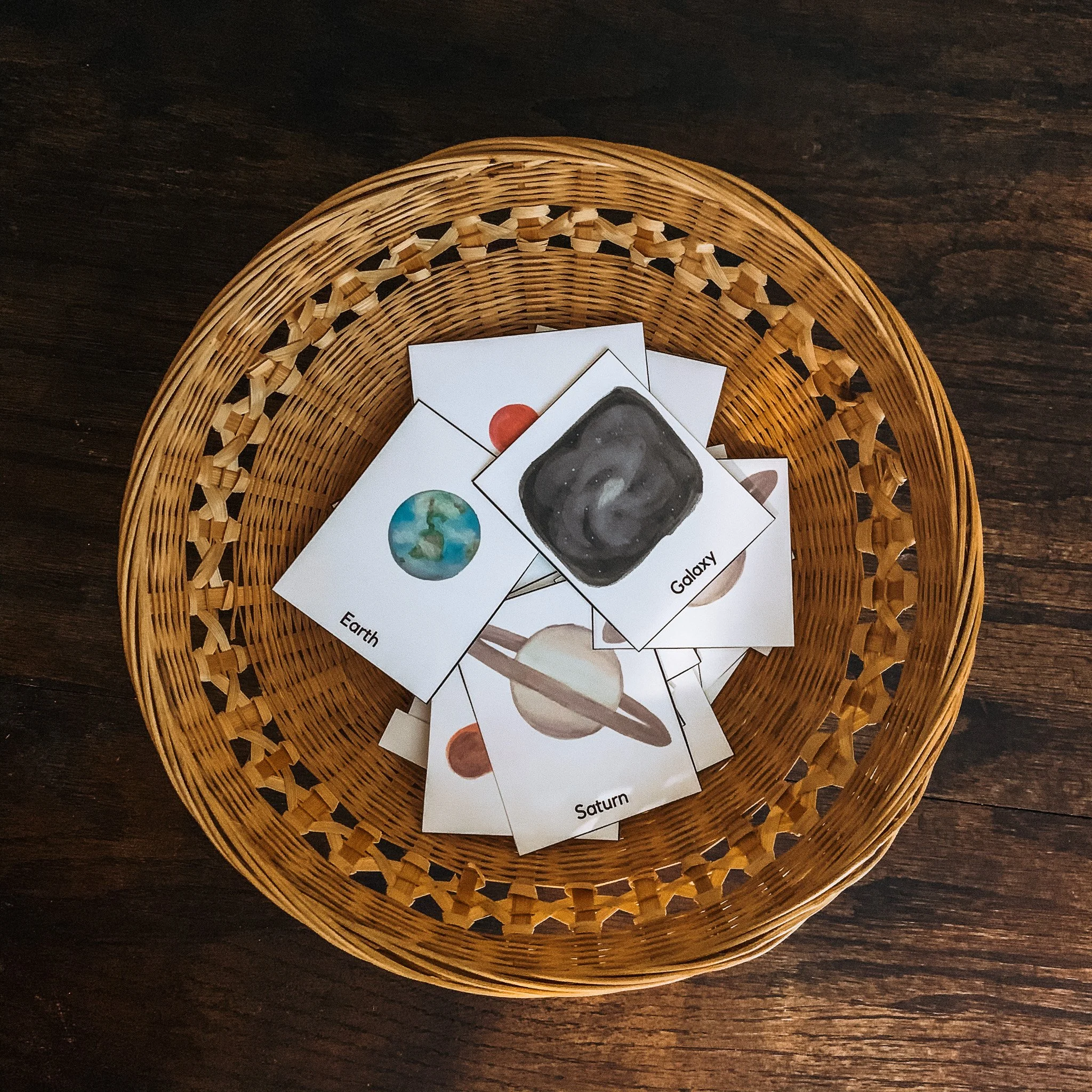
A reference or printable, often. A 3-part card, a nomenclature card, a photograph, a page from a book, an art print. This anchors the play in something real and gives older children a way to extend the experience into language, reading, or research.
A defined space. A tray, a placemat, a low shelf, a small basket. The boundary keeps materials contained and signals “this is the work for now.”
Beauty. This is not optional. Beauty is functional in this context. A clean, intentional arrangement makes the child want to engage. A jumbled pile does not.
How to Set Up an Invitation to Play (Step by Step)
You do not need fancy shelves, a craft closet, or a single new item. Promise. Here is the workflow I use at home.
Step 1: Notice what they are curious about right now. Bugs after a rainstorm? The moon last night? Pouring water into every cup they can find? This is your starting point. Curiosity is already there. Your job is to feed it.
Step 2: Pick one focus. Translate that curiosity into a single theme. “Pouring.” “Wildflowers in the yard.” “How seeds grow.” “The phases of the moon.” One theme is enough.
Step 3: Gather three to five materials. Walk through your house, your yard, and your craft drawer. Pull together a few items that fit the theme. Mix something natural, a tool, and a printable or reference if you have one. Keep it limited.
Step 4: Arrange it beautifully on a tray, mat, or low table. Use what you have. A wooden cutting board works as a tray. A folded napkin works as a mat. Place things with a little intention. Negative space matters.
Step 5: Place it where they will find it. A low table, a small shelf, the kitchen counter, a corner of the playroom. Then walk away.
Step 6: Step back and observe. No big introduction. No “look what I made for you!” Just smile if they catch you watching. Let them discover. Let them play.
Step 7: Write down what you noticed. A quick note on your phone is fine. What did they pick up first? What did they say? How long did they engage? This is the observational data that will make your next invitation even better.
Step 8: Rotate when interest fades. When the materials have been ignored for a few days, switch them out. Keep the tray, change what is on it. The container becomes a familiar friend, the contents stay fresh.
That is the whole process. Five to ten minutes of setup can buy you an hour or more of meaningful play. It compounds.
Invitation to Play Examples by Age
Here are real, doable examples for different ages and stages. Mix and match. Pull from what you have.
Toddlers (Ages 18 Months to 3)
Toddlers need bigger, simpler, sturdier materials. They are sensory creatures. Choking hazards are real. Keep groupings to two or three items.
Pouring station. A small pitcher of water, two small cups, and a sponge on a tray with a low rim. Magic for a 2 year old.
Pinecone basket. A basket of pinecones, a wooden bowl, and a pair of large kitchen tongs. Transferring practice that builds hand strength.
Color sort. A muffin tin, a basket of pom poms or fabric scraps in three colors, and a wooden spoon. Open ended sorting.
Nature tray. A handful of leaves and acorns from a walk, a small magnifying glass, a flat stone or log slice as a surface. Pure observation.
Preschool (Ages 3 to 5)
This age group can handle more materials and longer focus. They love rich vocabulary and small printables. This is the sweet spot for nature based learning.
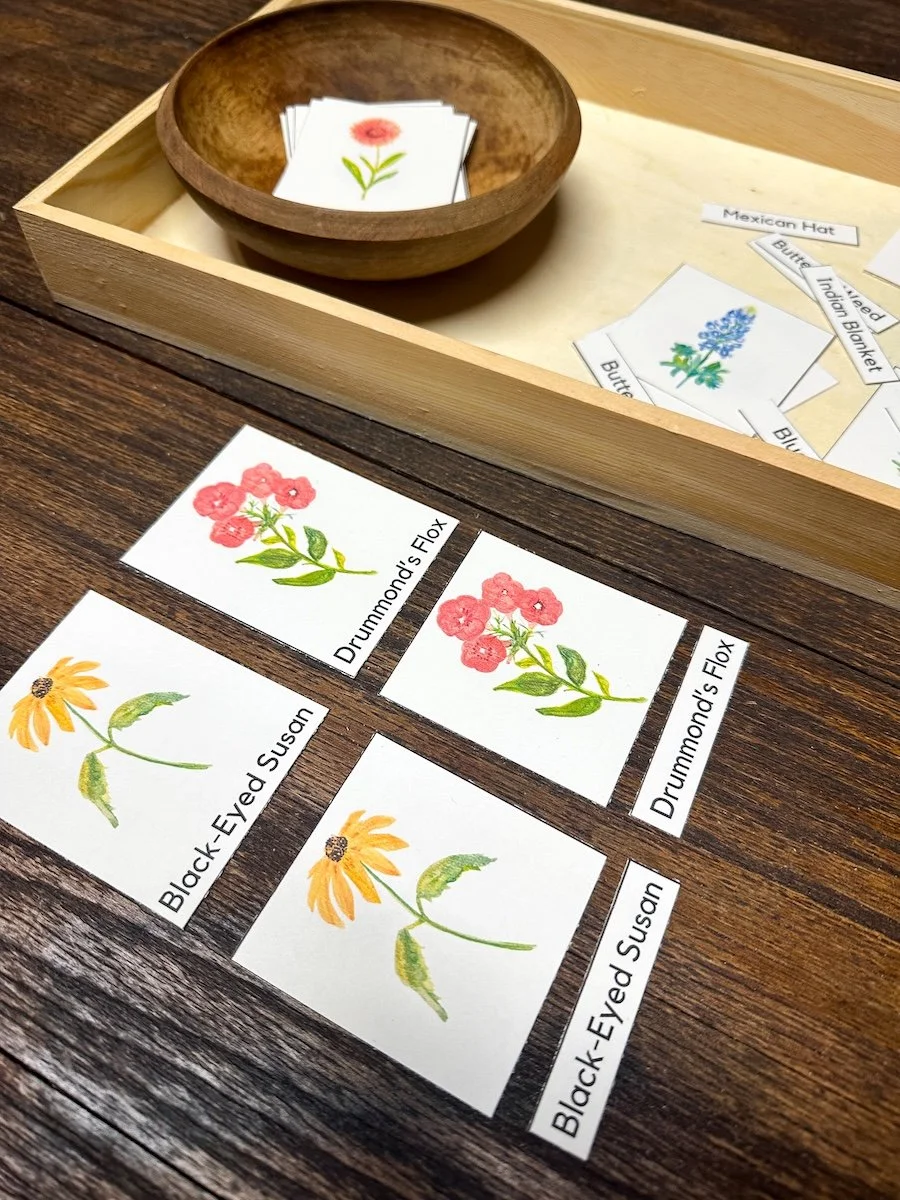
Wildflower naming station. A few Texas Wildflower 3-Part Cards, a small vase with fresh flowers from your yard or grocery store, and a magnifying glass. Beautiful for spring.
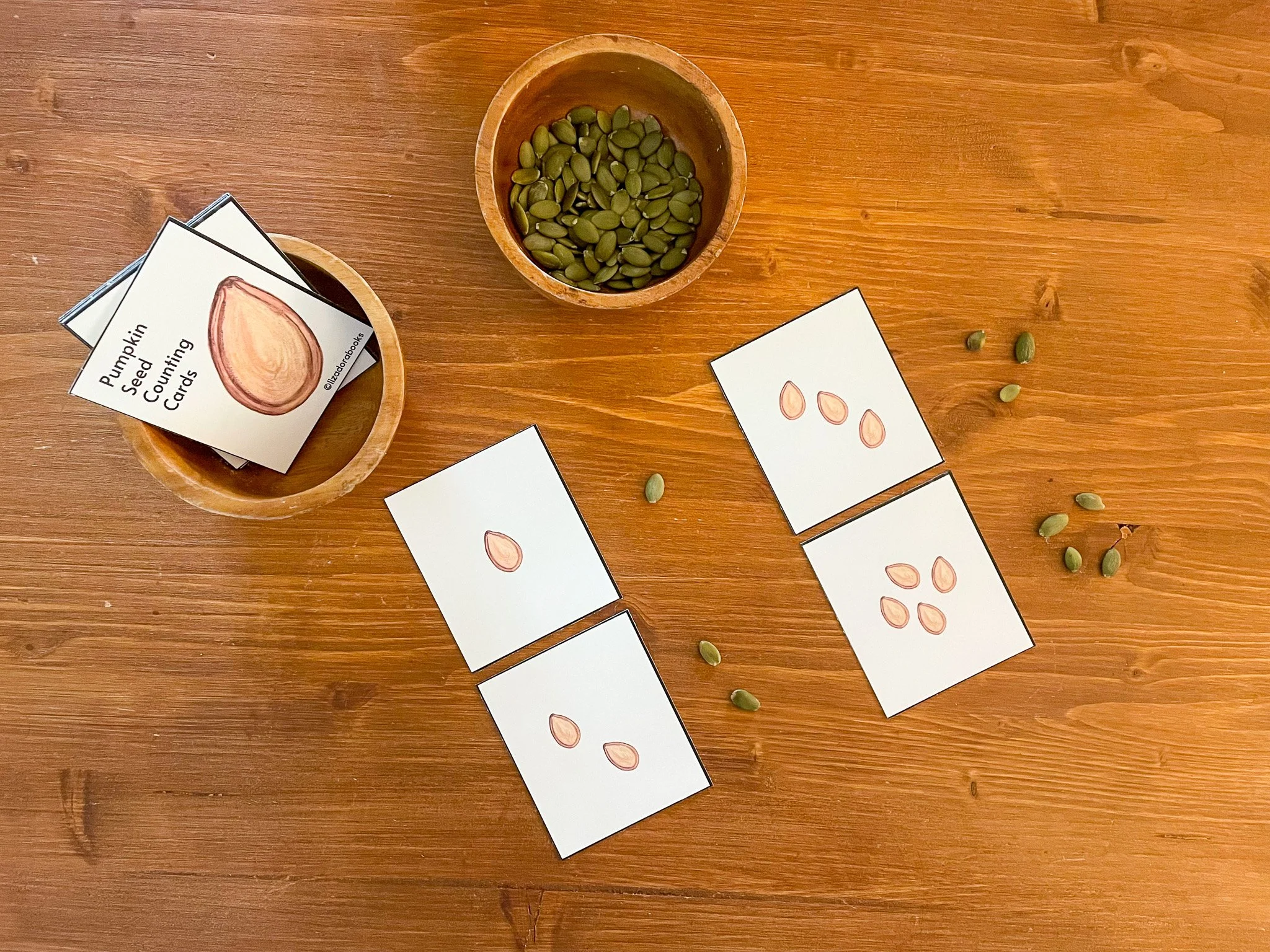
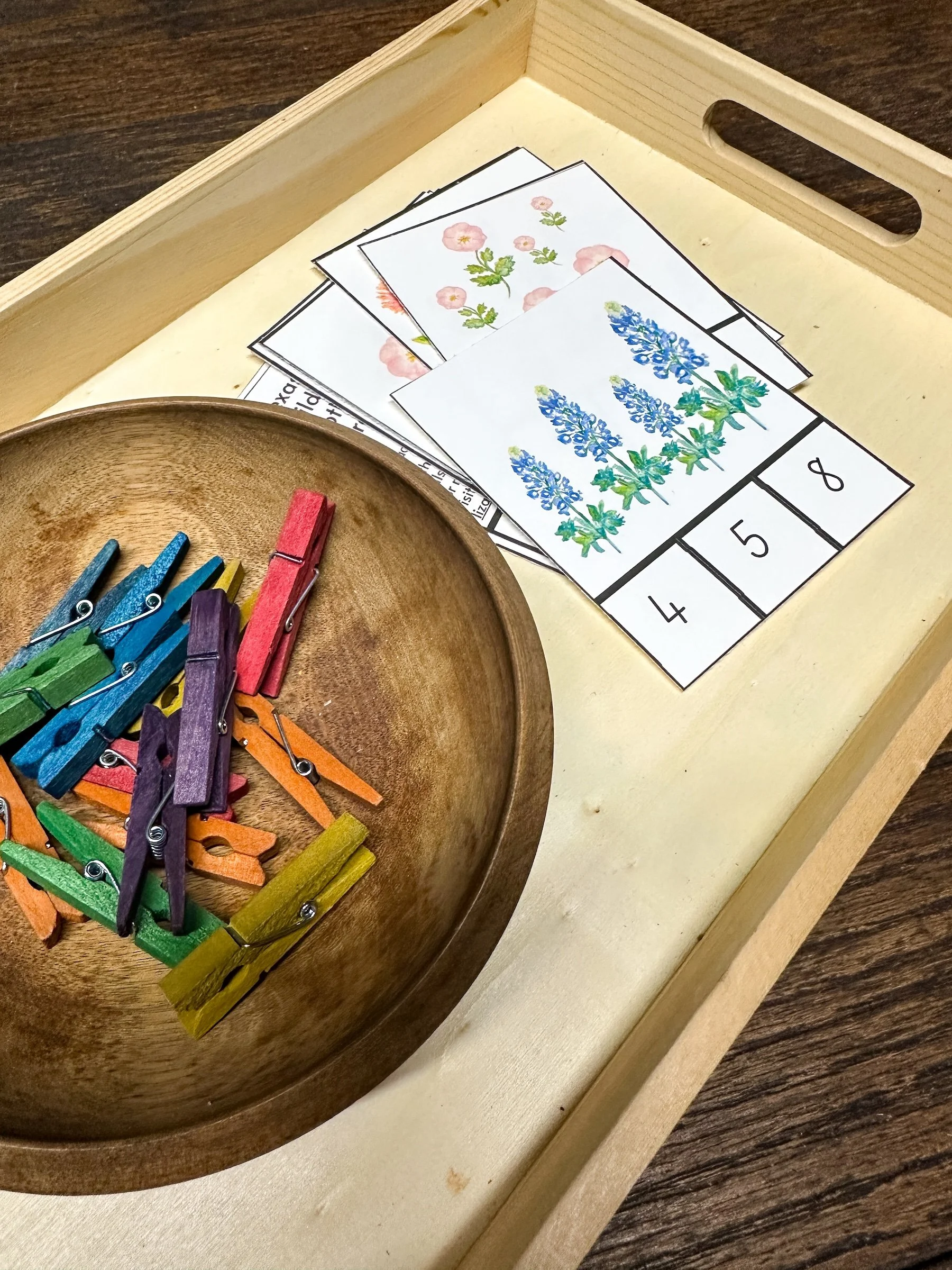
Counting tray. A few cards from a set like our Nature Counting Cards Bundle (we use the pumpkin seed set in fall, the wildflower set in spring, and the acorn set anytime), one wooden bowl of real seeds or acorns, and a pair of small tongs. Counting becomes hands on instead of abstract.
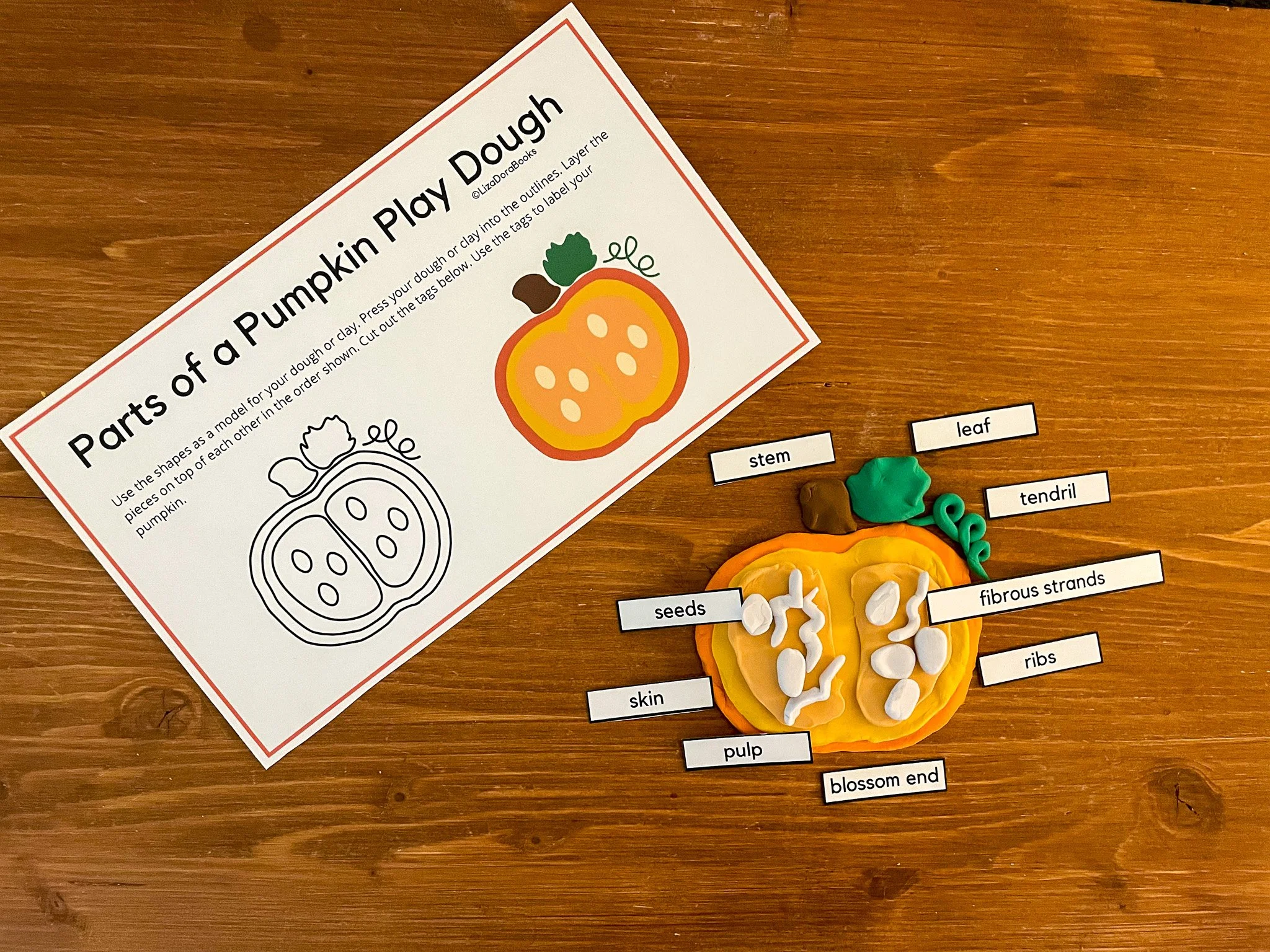
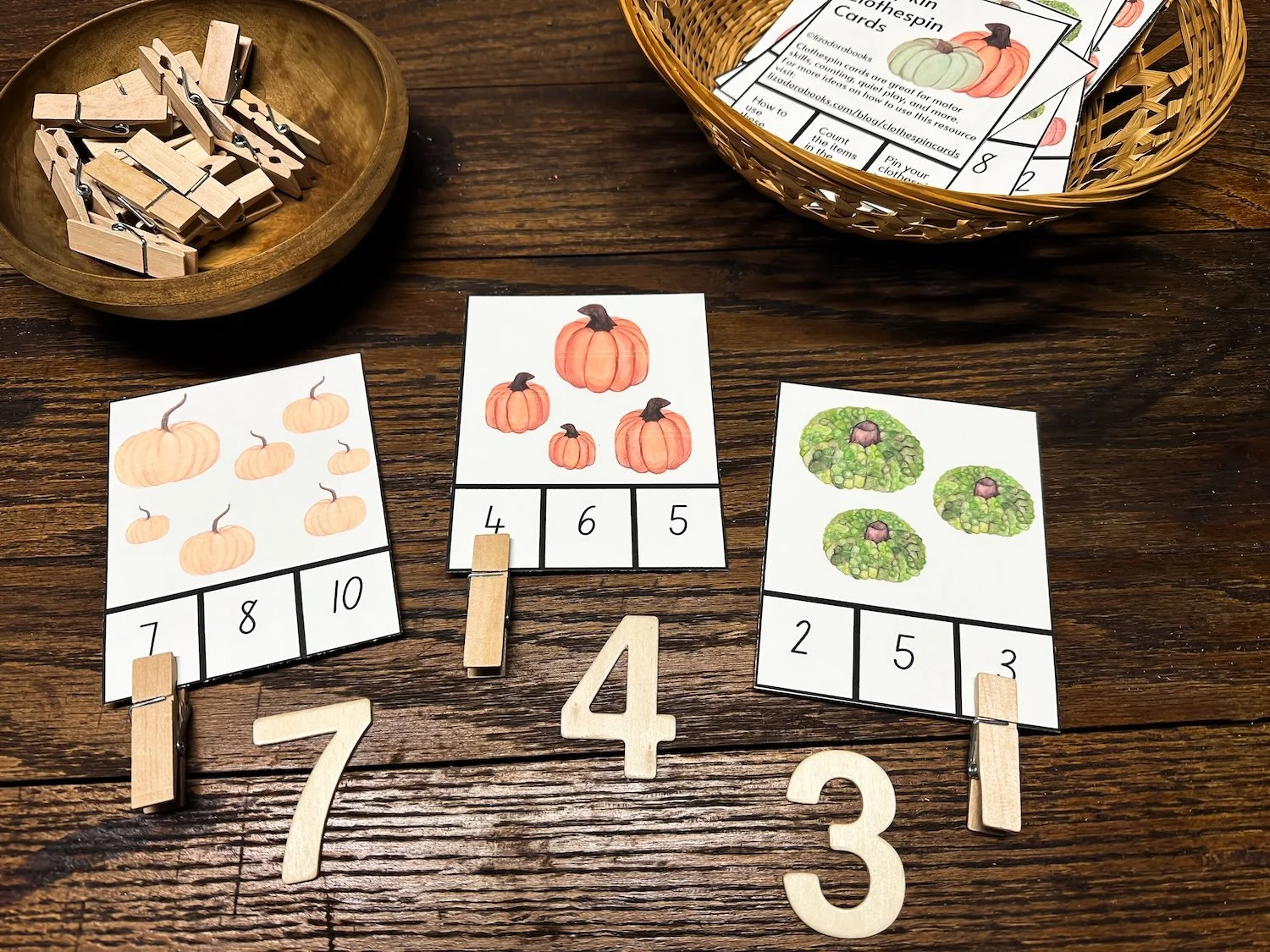
Clothespin counting. A few Texas Wildflower Clothespin Cards or Pumpkin Clothespin Cards and a small basket of mini clothespins. Math and fine motor in one.
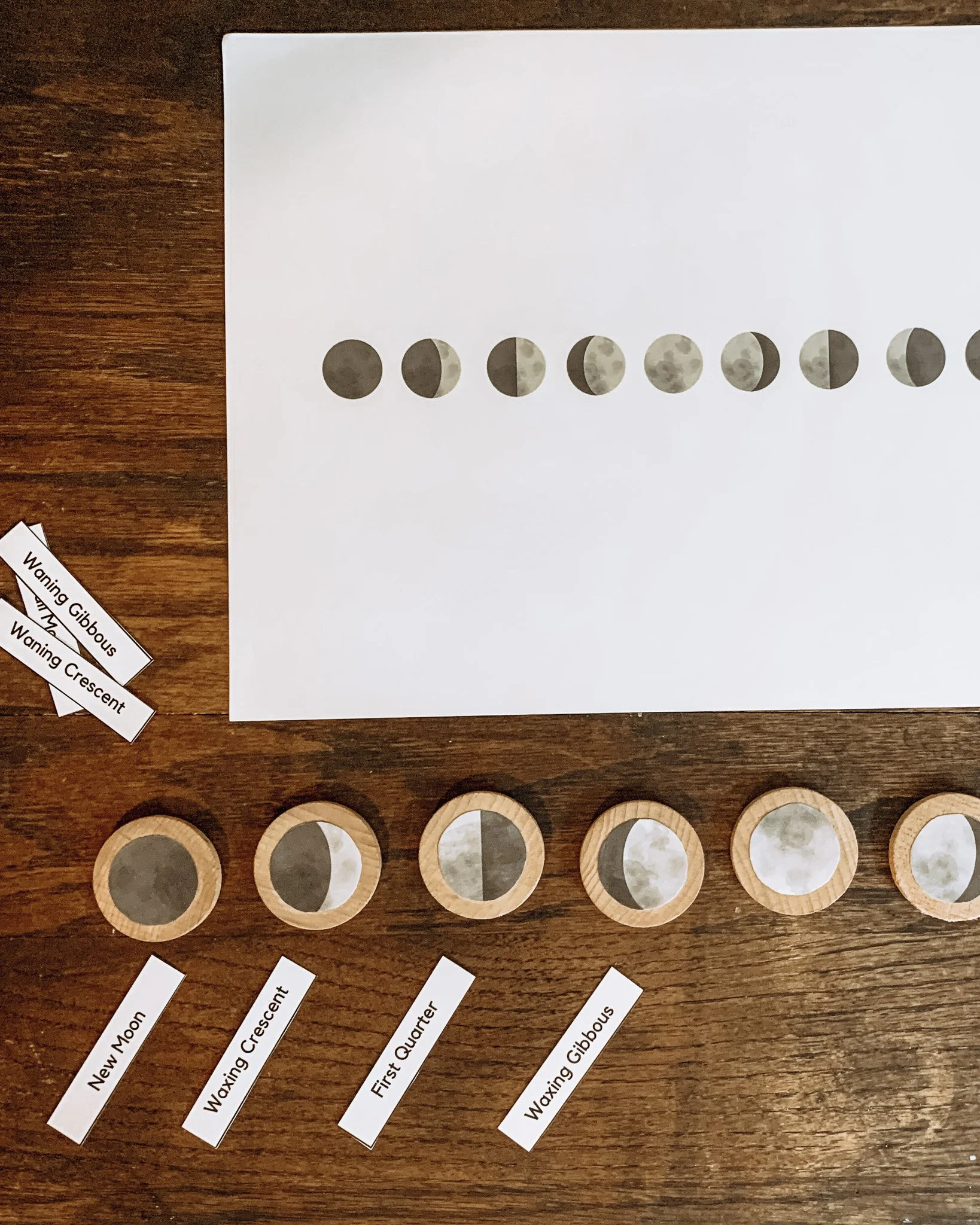
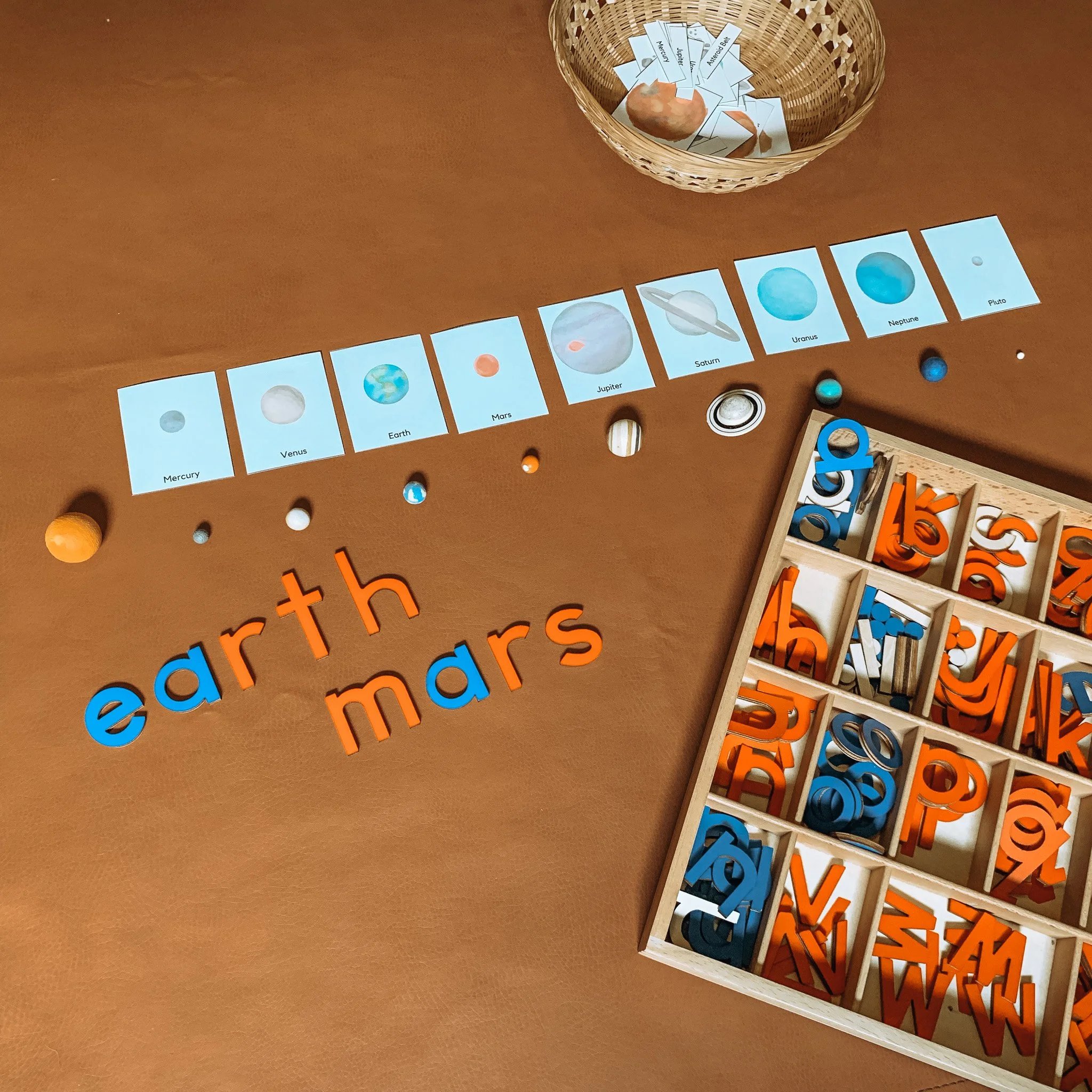
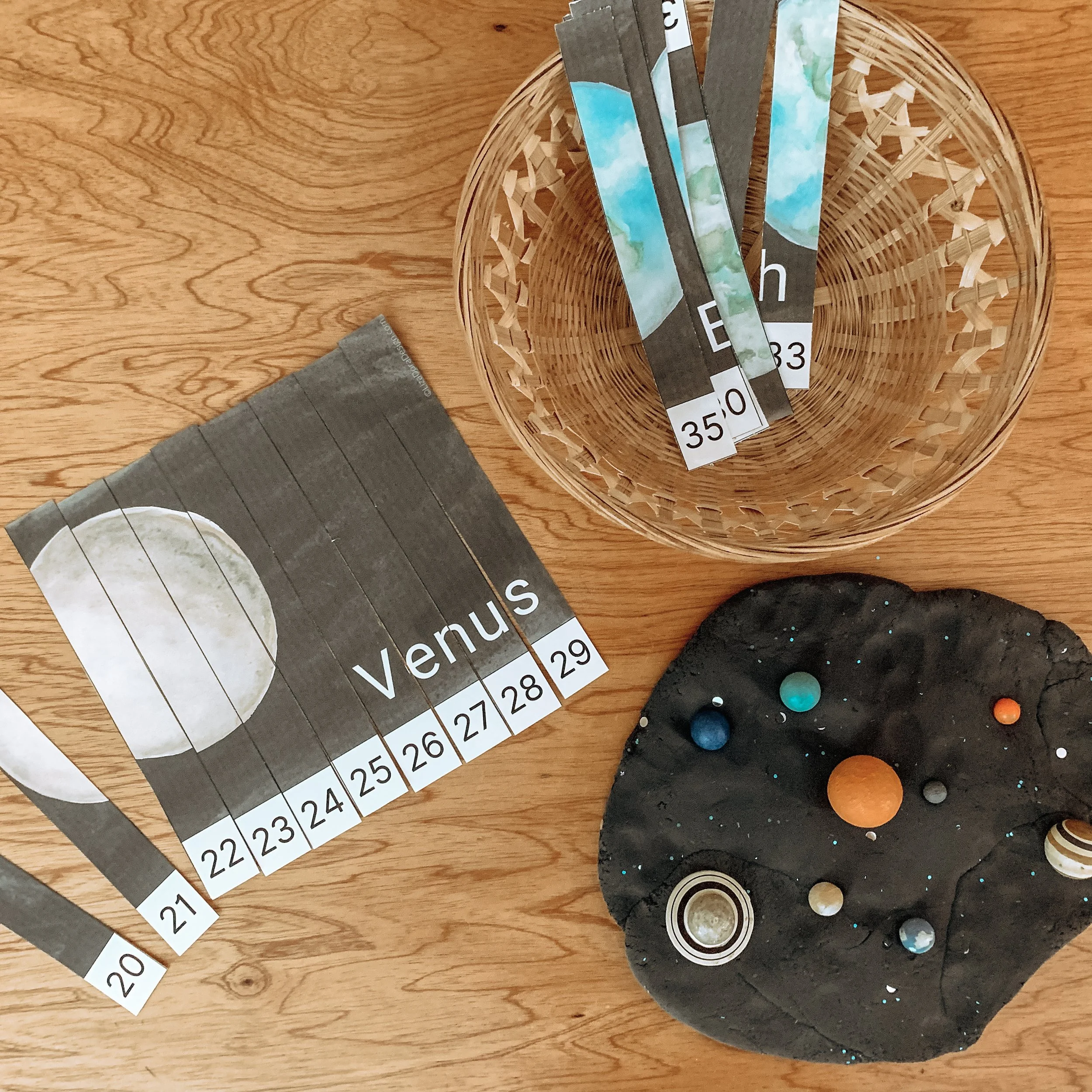
Moon observation. A few moon phase cards from our Moon and Phases Unit Study or Moon Unit Early Learning Bundle, a small flashlight, a styrofoam ball or orange, and a black piece of fabric. Set the stage and they will recreate the orbit on their own.
Early Elementary (Ages 5 to 8)
Older kids love adding clipboards, journals, magnifying glasses, and reference materials. They want to document. Lean into that.
Bluebonnet dissection. A fresh bluebonnet (or any flower if you are not in Texas in spring), our Bluebonnet Anatomy 3-Part Cards, a magnifying glass, tweezers, and a piece of white paper as a workspace. The flower comes apart, and a real botany lesson happens. Pair with our Bluebonnet Anatomy Mini Unit for fill in the blank pages and a watercolor painting project.
Cicada study. A few activities from our Cicada Unit Study, a real cicada exoskeleton if you can find one (Texas summers, hello), a magnifying glass, a clipboard, and pencils. The cicada study covers life cycle, anatomy, math, literacy, art, and STEM, so you can pull whatever activity matches their current curiosity.
Art study. Our Texas Wildflower Art Study printable, watercolors, paper, and a small jar of water. Kids look at how a real artist painted flowers, then make their own response. Quiet, focused, and beautiful.
Fall science tray. Pumpkin seeds, acorns, a piece of bark, a small notebook, and a few cards from the Fall Early Learning Bundle. Sorting, observation, free writing.
You will notice every example pulls from what you already have plus one printable to anchor the language. That is the whole formula.
Common Mistakes (And How to Skip Them)
I have made every one of these. They are gentle to fix.
Putting out too many materials. When in doubt, take something off the tray. Less is almost always more. If your kid pulls everything off and ignores it, that is the tray talking.
Taking over. Setting up an invitation and then narrating, demonstrating, or correcting defeats the purpose. The whole point is child led discovery. Set the stage, then leave the stage.
Expecting a specific outcome. If you laid out paint, paper, and leaves and your kid uses the leaves as boats in the cup of water you also put out, you did not fail. You succeeded. The materials are open ended on purpose.
Skipping beauty. A pile of stuff in a plastic bin signals “play with this if you must.” A small basket with a folded napkin underneath signals “this is for you.” Same materials, very different invitation.
Setting it up and hovering. Walk away. Read a book. Do dishes. Be present but not on top of them. They will come find you when they want to share.
Giving up after one flop. Sometimes a setup just does not land. The kid is tired, they are not in the mood, the moment is wrong. Try again in a few days with a small twist. Kids change fast.
How Often to Rotate (and How to Not Lose Your Mind)
You do not need a new invitation every day. That is a recipe for burnout, and it is not even better for the child.
A few rhythms that work:
One invitation per week. Set it up Monday morning, leave it out all week, change it the next Monday. Easy and sustainable.
Two trays in rotation. Have one “active” invitation out and one resting on a shelf. When interest fades on the active one, swap them. Even small changes feel fresh to a young child.
Seasonal swaps. Fall pumpkin tray. Winter pinecone tray. Spring wildflower tray. Summer water and shells tray. The seasons do the heavy lifting for you.
Follow their lead. If a setup has captured your kid for a week, do not change a thing. If a setup is being ignored after one day, switch it sooner. There is no rule.
The container can stay the same (same tray, same shelf, same little corner). The contents change. That is plenty of novelty for most kids.
Materials You Already Own
Before you buy anything, look around. You almost certainly have everything you need.
A wooden cutting board or small tray. A few small bowls. A muffin tin. A handful of pinecones, acorns, or pebbles from outside. A few pieces of fabric or felt. A magnifying glass (or a clean glass jar that magnifies a little when you peer through it). A pair of tongs from the kitchen. Small clothespins. A spoon. A pitcher. A flashlight. A notebook and a pencil. A printable or two from your shelf, your library, or our shop.
That is a full month of invitations to play, easily, with zero new purchases. The printables I create are designed to drop right into setups like these, with watercolor illustrations that look beautiful next to real natural materials. But the magic is in the curiosity, not the cost.
Frequently Asked Questions About Invitations to Play
What age is an invitation to play appropriate for?
From around 12 months all the way through elementary school, with adjustments. Younger toddlers need bigger, simpler, choke proof materials and shorter sessions. Preschoolers thrive with three to five item setups and printables. Older kids love added tools like clipboards, journals, and reference materials. The format scales with the child.
How is an invitation to play different from a regular activity?
A regular activity usually has a goal and an end product (make this craft, complete this worksheet, follow these instructions). An invitation to play has materials but no required outcome. The child decides what to do, how long to do it, and when they are finished. The adult sets the stage and then steps back.
What is the difference between an invitation to play and an invitation to create?
An invitation to create is a specific kind of invitation to play focused on art and making (paint, paper, collage materials). An invitation to play is the broader category and can include anything: pouring stations, sorting trays, nature observation, math materials, dramatic play setups. All invitations to create are invitations to play, but not all invitations to play are art focused.
Do I need Montessori materials or fancy shelves?
No. You can run beautiful invitations to play on a kitchen counter with materials from your backyard and your craft drawer. Real Montessori shelves and materials are lovely if you already have them, but they are not the point. The point is intentional, child led play with thoughtful materials. That can happen anywhere.
How long should an invitation to play last?
As long as your child is engaged, plus a little longer. Toddlers might play for 10 to 20 minutes. Preschoolers can stretch to 30 to 60 minutes when truly absorbed. Older kids can spend an hour or more on a setup that hooks them. Resist the urge to interrupt. Long stretches of focused play are exactly what you are trying to grow.
My kid ignored my beautiful setup. What did I do wrong?
Probably nothing. Sometimes setups flop. Maybe they are tired, hungry, in a different mood, or interested in something else right now. Leave it out for a day or two and see if they come back to it. If not, swap one element (different tool, different printable, different natural material) and try again. Every flop is data for the next setup.
Can I do an invitation to play with multiple kids at once?
Yes, with a small tweak: set up enough materials so each child has their own, or a clear shared workspace with materials that can be used in parallel. Avoid setups where two kids will need the same single tool. For mixed ages, lean toward materials the youngest can safely handle and let the older child extend with reference cards, journals, or related printables.
How do I clean up at the end?
Involve them. Cleanup is part of the learning, especially in the Montessori tradition. Show them once, then expect them to participate. Small kids can carry a tray to the shelf. Older kids can wash and dry a bowl. Cleanup as a routine teaches respect for materials and personal responsibility.
Ready to Set One Up This Week?
You already have what you need. Pick a focus. Gather three to five materials. Arrange them beautifully. Step back. That is the whole practice.
If you want to add one of our printables to anchor the vocabulary or science, every product in the Liza Dora Books shop is designed for setups exactly like the ones we just walked through. The 3-part cards, clothespin cards, art studies, and unit studies all drop right into invitations to play. They feature original hand painted watercolor illustrations, instant digital download, and unlimited printing for your home or classroom.
A few favorites to start with:
Texas Wildflower 3-Part Cards: Eight native species, ages 3 to 12. Beautiful for spring nature trays.
Nature Counting Cards Bundle: Wildflowers, acorns, and pumpkin seeds, numbers 1 through 10. Pairs with real loose parts.
Bluebonnet Anatomy 3-Part Cards: Botany vocabulary, perfect for a flower dissection invitation.
Cicada Unit Study: Sixteen activities across science, math, literacy, art, and STEM. Endless invitation fuel.
Texas Wildflower Art Study: A guided art appreciation experience that pairs with paint, paper, and observation.
Texas Wildflower Clothespin Cards and Pumpkin Clothespin Cards: Counting plus fine motor, in two seasonal flavors.
Moon and Phases Unit Study and Moon Unit Early Learning Bundle: Phases, lunar tracking, and a hands on orbit project.
Fall Early Learning Bundle: Everything you need for a full season of fall trays.
Bluebonnet Anatomy Mini Unit: A deeper botany dive with fill in the blank pages and a watercolor template.
I would love to hear what you set up and how it goes. Tag me on Instagram @lizadorawrites or send me a note. The whole point of this little brand is to help you build a slower, more curious, more screen free corner of childhood for your kids. An invitation to play is one of the gentlest, most beautiful tools for doing exactly that.
You are already doing the hard and beautiful work of raising curious kids. This is one more way to make the days feel lighter and richer at the same time.
Happy playing.
Liza Dora is a former chemistry teacher, children’s book author and illustrator, and the creator of Liza Dora Books, a collection of Montessori inspired printable learning materials featuring original watercolor artwork. She lives in Texas with her husband and two kiddos, where the invitations to play usually involve a tray, a few wildflowers, and at least one cicada exoskeleton.