What Is an Art Study? A Simple Guide for Parents and Teachers
If you've ever watched a child stare at a painting and ask "Why did they make it look like that?" you already know something important: kids are natural art critics. They notice things. They ask questions. They have opinions about color and shape and feeling before anyone teaches them the vocabulary to describe it.
An art study takes that instinct and gives it room to grow.
Whether you're a homeschool parent looking for a gentle way to add art appreciation to your week, a classroom teacher searching for something meaningful that doesn't require a full art supplies closet, or a parent who wants screen-free activities that go deeper than coloring pages, art studies are one of the simplest and most rewarding things you can do with kids. And you don't need an art degree to lead one.
Here's everything you need to know about what an art study is, why it works, and how to do one with your kids this week.
What Exactly Is an Art Study?
An art study is a focused look at a work of art. That's it at its core.
The child looks closely at a painting, drawing, or other artwork. They observe the details. They think about what they see, what the artist might have been trying to do, and how the piece makes them feel. Then they talk about it, write about it, or create something inspired by it.
There's no quiz. There's no right or wrong answer. The goal isn't to memorize dates and movements. The goal is to really see the art and to practice the skill of paying attention.
You might also hear this called picture study (the Charlotte Mason term), artist study (when you focus on one artist over several weeks), or simply art appreciation. The names vary, but the core idea is the same: slow down, look carefully, and let the art do the teaching.
Where Does This Idea Come From?
The concept of studying art with children has been around for well over a century. Charlotte Mason, a British educator writing in the late 1800s, built picture study into her educational philosophy as a core subject, not an elective or an add-on. She believed that children deserved exposure to great art just as much as they deserved great literature, and that they were fully capable of engaging with masterworks on their own terms.
Her method was disarmingly simple: choose an artist, spend several weeks studying a handful of their paintings, and let the child look, observe, and narrate what they see. No lectures. No flashcards. Just quiet attention followed by conversation.
That approach has resonated with homeschool families for decades, particularly in Charlotte Mason and classical education circles. But you don't need to follow any particular philosophy to benefit from it. Art study works because it taps into something universal: children are curious, they notice details adults miss, and they love being asked what they think.
Teachers have been using similar techniques in classrooms for years. Research from schools across California found that using classic works of art with young students improved their ability to observe closely, think critically, and discuss ideas respectfully. Studies on comprehensive art education have shown that it strengthens creativity, critical thinking, and even performance in reading and math.
In other words, this isn't a soft extra. It's a real learning tool with real results.
What Skills Does an Art Study Build?
The list is longer than most people expect, especially for an activity that looks so simple from the outside.
Observation and attention to detail. The core skill of any art study is looking, and looking carefully. Children learn to notice brushstrokes, color choices, composition, light, shadow, and subject matter. This habit of close observation carries into science, reading comprehension, and everyday problem-solving. Charlotte Mason called it "the habit of attention," and she considered it one of the most valuable things a child could develop.
Critical thinking. When a child looks at a painting and you ask "What do you notice?" instead of "What is this about?", you're inviting them to analyze rather than summarize. They start making inferences, comparing, questioning, and forming their own interpretations. That's critical thinking in its purest form.
Language and self-expression. Describing what you see in a piece of art requires vocabulary. Kids reach for words like "vibrant" and "delicate" and "chaotic" that they might not use in everyday conversation. For younger children who are still developing language skills, art gives them a bridge between what they feel and what they can say.
Cultural awareness. Art is one of the shared languages of the world. Studying paintings from different time periods and cultures introduces children to different perspectives, histories, and ways of seeing. It teaches empathy and respect for diversity in a way that feels natural, not forced.
Creativity and imagination. After studying how a real artist approached a subject, children often feel inspired to create their own work. Not copying, but responding. That cycle of looking, thinking, and making is the foundation of creative confidence.
Focus and patience. In a world that moves fast, art study asks kids to slow down. Sit with one image. Look at it for more than three seconds. Notice something new. That five minutes of quiet attention is a skill that benefits every other subject in their day.
How to Do an Art Study with Kids (Step by Step)
You don't need special training or materials. Here's how to lead an art study at home or in the classroom in about 15 to 20 minutes.
Step 1: Choose a piece of art. Pick one painting or artwork to focus on. Print it out (at least 8.5 x 11 inches so kids can see details) or display it on a screen. If you're studying a single artist over several weeks, choose one new piece each week.
Step 2: Look quietly. Give the children time to study the artwork in silence. For younger kids (ages 5 to 7), two to three minutes is plenty. Older kids can look for five minutes or more. This quiet looking is the most important part. Resist the urge to talk during it. Let their eyes do the work.
Step 3: Ask open-ended questions. After the quiet time, start a conversation. Avoid questions with one right answer. Instead, try prompts like: What do you notice first? What colors do you see? How does this painting make you feel? What do you think is happening here? What do you think the artist wanted you to notice? If you could step inside this painting, what would you hear or smell?
Step 4: Share a little context. After the children have shared their own observations, offer a few facts about the artist or the painting. When was it made? What was the artist known for? What materials did they use? Keep this brief. The child's own observations should always come first. The facts are seasoning, not the main course.
Step 5: Respond creatively (optional but powerful). Invite the child to create something inspired by what they studied. This could be a drawing, a painting, a poem, a story, or even a nature walk to find something that reminds them of the artwork. The response doesn't need to look like the original. It just needs to come from the child's own connection to what they saw.
Step 6: Leave the art out. If possible, leave the print somewhere visible for the rest of the week. On the refrigerator, propped on a shelf, pinned to a bulletin board. Children will glance at it throughout the week and notice new details each time. This passive exposure is part of the learning.
You Don't Need to Be an Art Expert
This is the part that trips up most parents and teachers. "I don't know anything about art" is the number one reason people skip art study entirely.
Here's the truth: the only qualification for art appreciation is being a human who can look at something and have a thought about it. You already have that.
You don't need to know the difference between Impressionism and Post-Impressionism. You don't need to explain brushwork or perspective. You just need to put a beautiful piece of art in front of a child and ask, "What do you see?"
The child does the rest. And honestly, they're often better at it than adults. They haven't learned to overthink art yet. They'll tell you the sky looks angry, or the flowers look like they're dancing, or the woman in the painting seems lonely. Those observations are valid, insightful, and exactly what art study is for.
Your job is to offer the art and make space for the conversation. That's it.
How Art Studies Connect to Nature
Some of the most powerful art studies happen when the artwork connects to something a child can see, touch, or experience in real life.
Think about it this way: studying a painting of flowers is interesting. Studying a painting of flowers and then walking outside to find those same flowers growing in your yard is transformative. Suddenly the art isn't something that exists only in a museum or a book. It's connected to the child's own world.
This is why nature-based art studies work so well, especially with younger children. When the subject matter is something they can observe firsthand (wildflowers, insects, landscapes, animals), the art study becomes a bridge between indoor learning and outdoor exploration. The child looks at how an artist painted a field of flowers, then goes outside and notices how the real flowers catch the light differently depending on the time of day. That's the kind of connection that sticks.
For families in Texas, spring is the perfect time for this. Bluebonnets, Indian paintbrush, and pink evening primrose start appearing along roadsides and in meadows from March through May. Kids notice them. They pick them. They ask what they're called. An art study that features these wildflowers takes a subject children are already curious about and deepens it through the lens of great artists who painted flowers and nature throughout history.
Art Studies for Different Ages
One of the best things about art study is how easily it scales.
Ages 5 to 7: Keep sessions short (10 to 15 minutes). Focus on observation prompts: "What colors do you see? What shapes? Does this painting remind you of anything?" Creative responses at this age might be drawing, painting, or building something with materials from nature. Don't expect polished narration. A few sentences of "I liked the red part because it looks like a sunset" is perfect.
Ages 8 to 10: Children at this age can handle longer quiet study (five minutes), more nuanced questions ("Why do you think the artist chose to paint it this way?"), and written responses. They're ready to compare two pieces by the same artist or explore how different artists approached the same subject. This is also a great age for connecting art study to other subjects, like linking a painting of wildflowers to a botany lesson.
Ages 11 to 12: Older kids can dig into historical context, discuss artistic techniques, and write extended responses (a paragraph reflection, a poem, or even a short essay). They can also begin to articulate personal taste: "I don't love this painting, but I respect how the artist used light to draw your eye to the center." That kind of analysis is exactly what art study builds over time.
Classroom teachers: Art study works beautifully as a weekly 15-minute routine. Choose an artist for the month, study one painting per week, and use the discussion as a warm-up or transition activity. It requires zero art supplies and fits into even the tightest schedule. Students who struggle with traditional writing prompts often thrive when asked to describe or respond to a visual work.
Getting Started This Week
If you've never done an art study before, here's the simplest possible way to start: pick one painting, print it out, sit down with your child, and look at it together. Ask what they notice. Listen. That's your first art study, and it will take less than ten minutes.
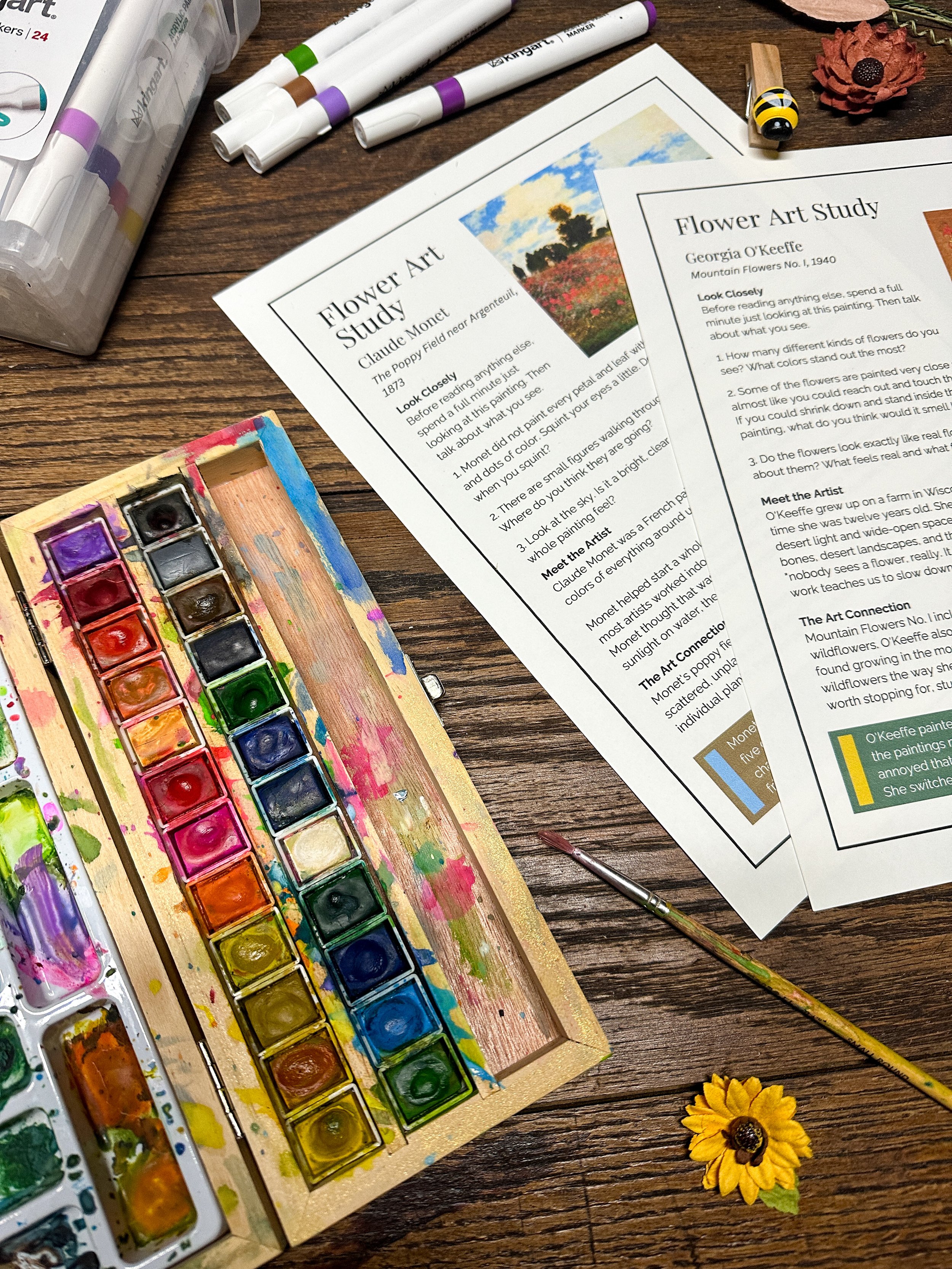
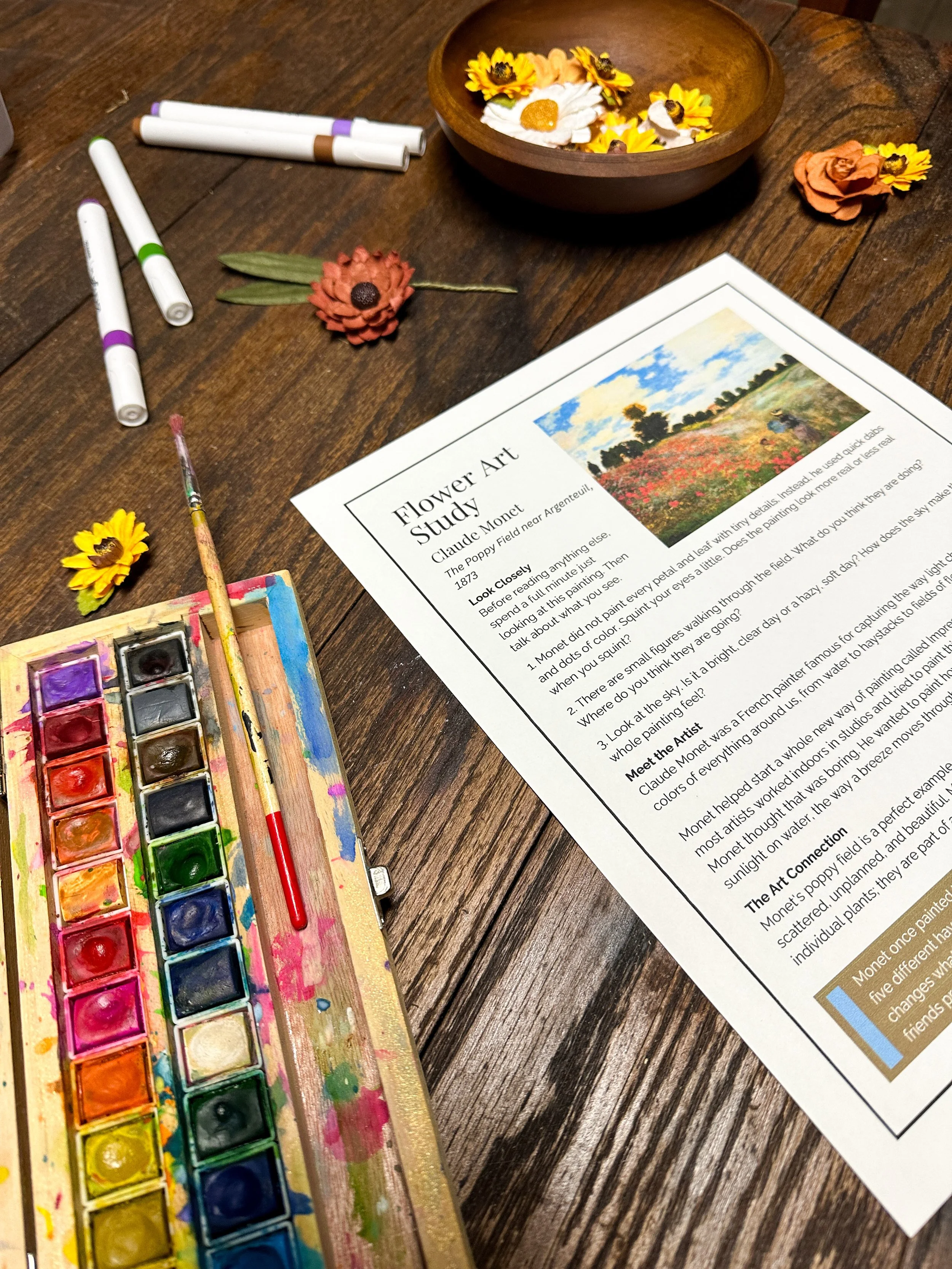
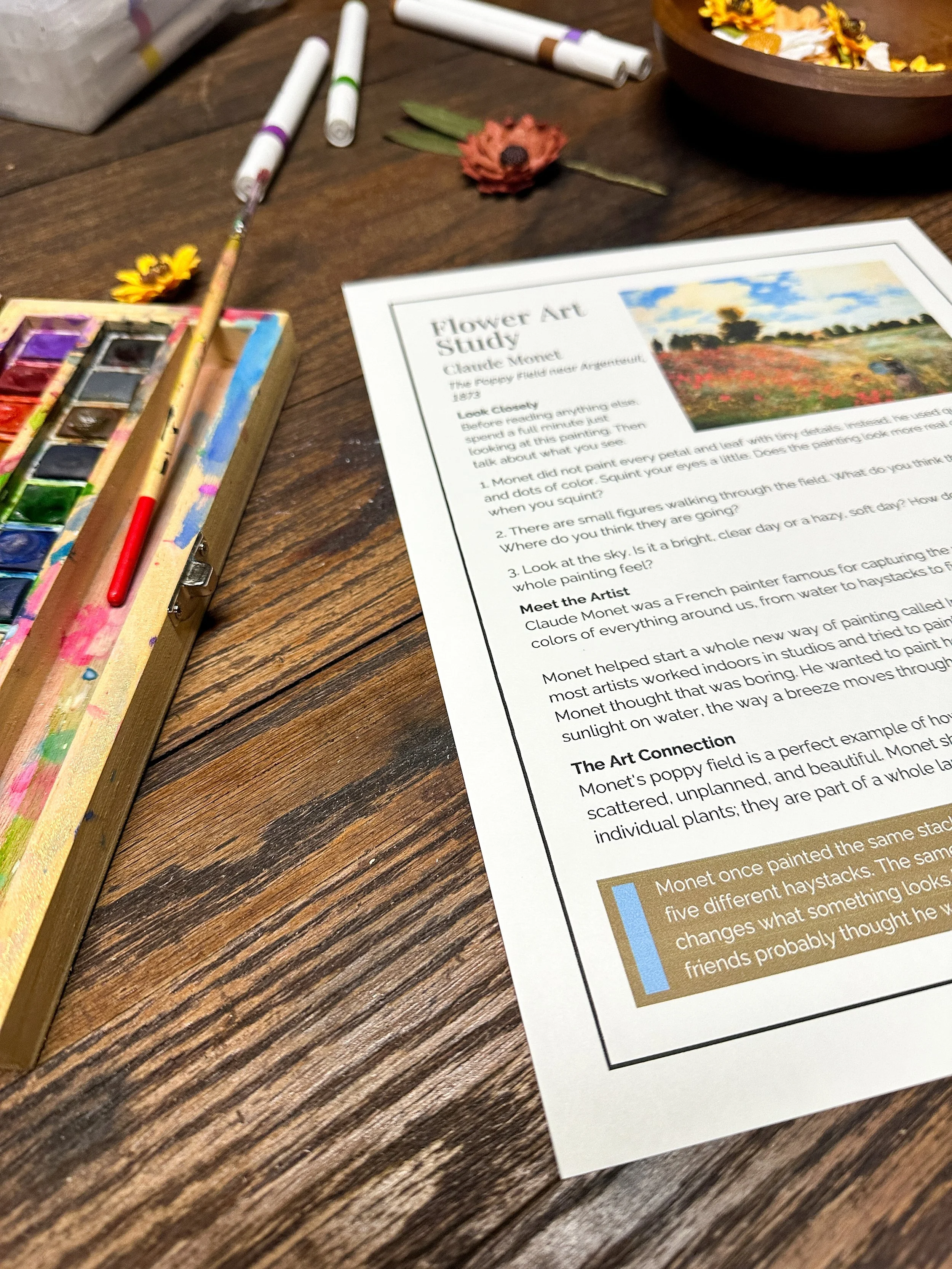
If you want something more structured to work with, our Texas Wildflower Art Study is designed to be a ready-to-go art study experience for ages 5 to 12. It features four famous works of art by artists who painted flowers and nature, each paired with guided observation prompts, background on the artist, and connections to Texas native wildflowers. A bonus extension page offers three creative paths: write a poem, tell a story, or create your own art inspired by what you studied.
Every page features original hand-painted watercolor illustrations (not clip art), because we believe the materials children learn from should be as beautiful as the art they're studying.
The set pairs naturally with our Texas Wildflower 3-Part Cards for a full Texas nature study that covers art appreciation, science vocabulary, and species identification. Use the art study for observation and creative thinking, then switch to the 3-part cards for hands-on botany and reading practice.
See wildflowers through the eyes of four world-famous artists! This printable art study pairs original hand-painted watercolor illustrations with masterworks by Claude Monet, Albrecht Dürer, and Maria Sibylla Merian. Your child will look closely at real paintings, learn about the artists who made them, and discover the connections between fine art and the wildflowers growing right outside your door. Ages 5–12.
🎨 The 4 Artist Studies:
Mary Vaux Walcott:
Alberta Paintbrush (Catilleja miniata)
, 1920,
Claude Monet: The Poppy Field near Argenteuil (1873)
Albrecht Dürer: The Great Piece of Turf (1503)
Maria Sibylla Merian: Branch with Beetles, Insects and Caterpillars (1705)
✏️ Bonus Extension Activity:
Choose your own creative path! Write a poem, write a short story, or create your own original artwork inspired by what you've studied. Three options so every learner can express what they've discovered in their own way.
🔍 Each Artist Page Includes:
"Look Closely" observation prompts that build visual literacy
"Meet the Artist" biography written just for kids
"The Art Connection" linking the artwork to wildflowers and the natural world
Fun Fact callout with surprising stories about each artist
What makes this study special:
🎨 Original watercolor artwork: a beautiful Texas wildflower bouquet on the cover, hand-painted by Liza Dora
🖼️ Real masterworks: your child studies actual paintings by Monet, Dürer, and Merian
🌸 Nature meets art: every study page connects fine art back to the wildflowers your child can find outside
👩🔬 Maria Sibylla Merian: one of the first women in scientific illustration. Her story alone is worth the download.
✏️ Three creative paths: the bonus extension lets kids choose poetry, storytelling, or visual art
📄 6 pages, zero filler: every page is designed to spark curiosity and conversation
Perfect for:
Charlotte Mason homeschool families, nature study groups, elementary art teachers, and anyone who wants their kids to see the world the way an artist does. Works beautifully alongside a spring wildflower nature walk.
How It Works:
Purchase and download instantly
Print the study pages (color printing recommended for the artwork)
Grab some colored pencils and a curious mind, and start looking closely!
No shipping wait. No subscription. Just download, print, and explore art!
Pairs With:
Texas Wildflower 3-Part Cards ($5) for learning 8 Texas wildflower species by common and scientific name. Bluebonnet Anatomy Mini Unit ($3 on sale) for a deep dive into the state flower's structure. Texas Wildflower Clothespin Cards ($3) for fine motor practice with wildflower matching. Nature Counting Cards Bundle ($5) for hands-on math with watercolor nature art.
Digital download. No product will be shipped.
Download is a high-quality PDF ready to print. Color print recommended. Some files arrive zipped — right-click (or use your Files app) to unzip/extract.
No refunds on digital downloads. If you have trouble with your order or download, contact support@lizadorabooks.com.
Featuring original artwork by Liza Dora. Materials may not be duplicated, distributed, or sold without express written permission from Liza Dora Books. Licensed for personal / household or single-classroom use (including one daycare group). For multi-classroom, school-wide, or district licensing, see /schools or email schools@lizadorabooks.com.More Nature-Based Learning
If your kids love connecting art and nature, explore our other Texas-themed printables:
Texas Wildflower 3-Part Cards (8 native species, ages 3-12): Montessori nomenclature cards with hand-painted botanical illustrations
Texas Wildflower Clothespin Cards (numbers 1-10, ages 2-6): Count-and-clip cards for math and fine motor practice
Nature Counting Cards Bundle (3 sets, ages 3-6): Wildflowers, acorns, and pumpkin seeds for hands-on math
Every product features original watercolor artwork, instant digital download, and unlimited printing for your home or classroom.
Happy studying!