What Are Clothespin Cards? A Parent’s Guide to This Simple Learning Tool
If you’ve spent any time on Montessori Pinterest or homeschool blogs, you’ve probably seen clothespin cards (also called clip cards or count and clip cards). They’re everywhere, and for good reason: they’re one of the simplest, most effective hands-on activities you can give a young child. My kids have mostly outgrown these, but as I pulled them out to photograph this weekend, both kids flopped down onto the floor to complete them. :)
If you’ve never used them, the concept might not be obvious from the photos alone. What are kids actually learning? Why clothespins instead of just pointing at the answer? And are they really worth the hype?
Short answer: yes. Here’s why, plus how to use them with kids from about age 2 through 2nd-ish grade.
How Clothespin Cards Work
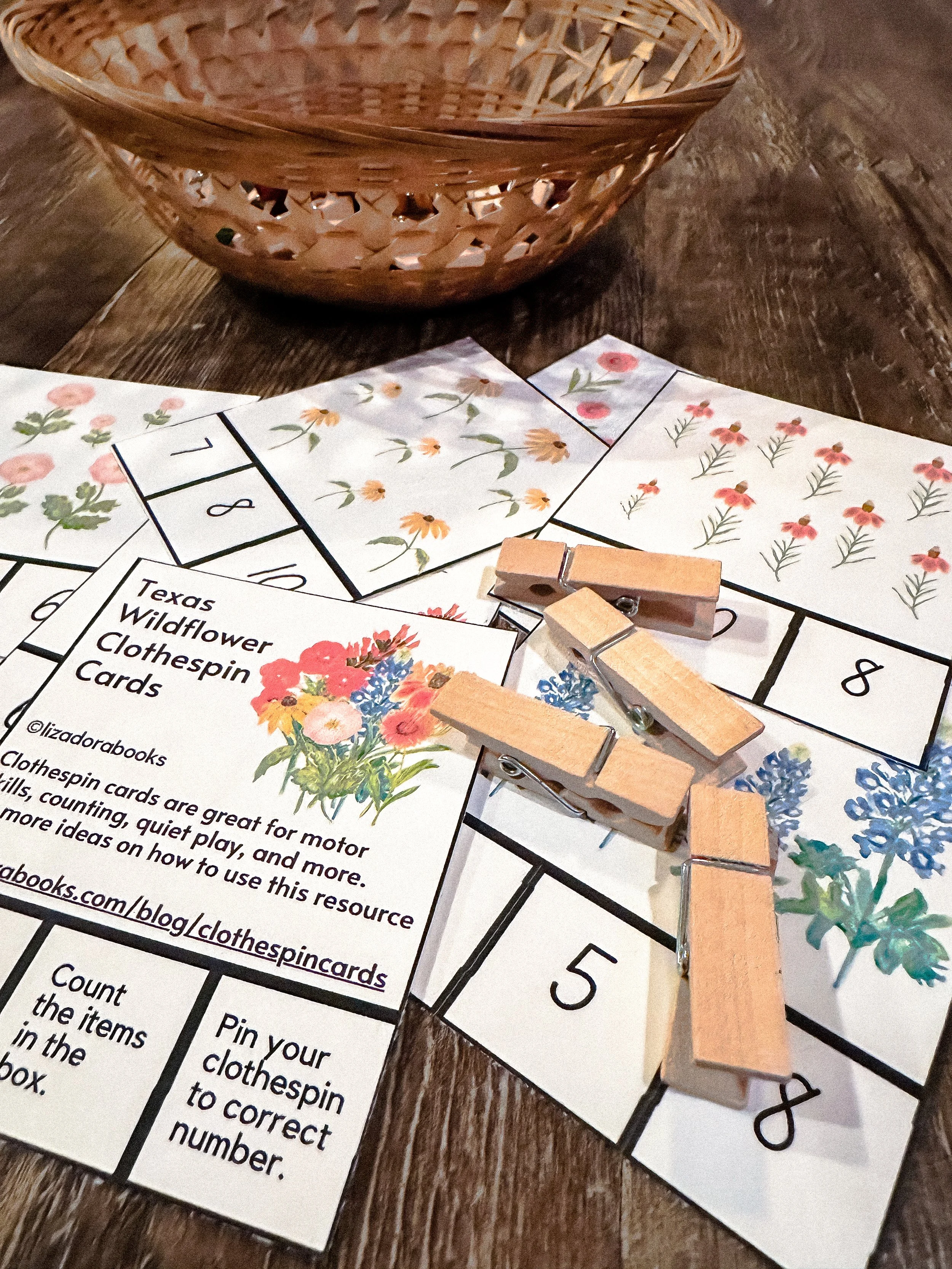
A clothespin card is a printed card with a question or prompt on it. The child figures out the answer, then clips a clothespin to the correct choice. That’s it.
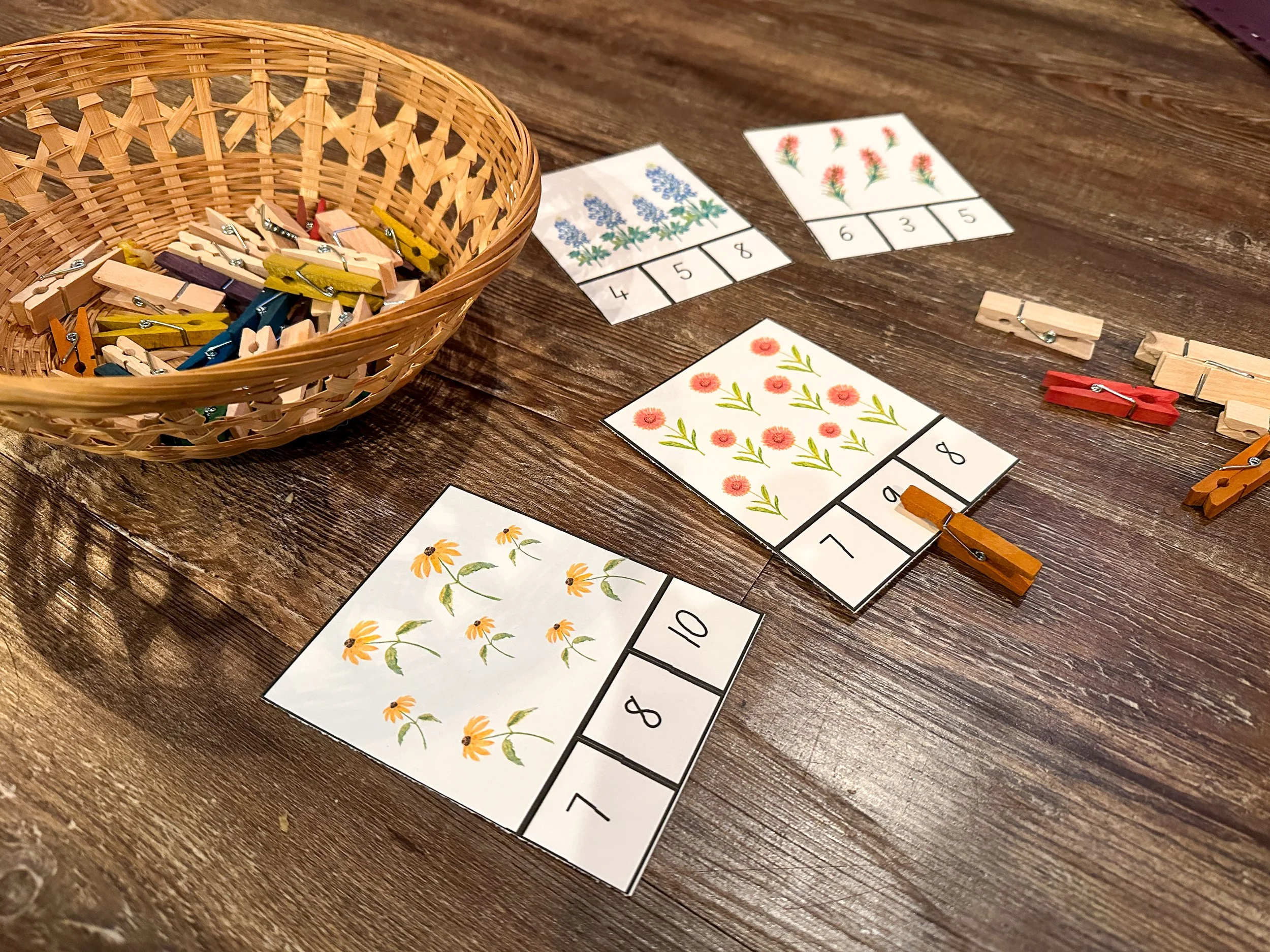
For counting cards specifically, the card shows a group of objects (flowers, bugs, acorns, whatever the theme) and a row of numbers along the edge. The child counts the objects, finds the matching number, and clips.
What makes this different from a worksheet is the physical action. The child isn’t circling an answer with a pencil. They’re picking up a clothespin, squeezing it open (which takes real effort for small hands), positioning it on the card, and releasing. That one motion builds hand strength, finger coordination, and the pincer grip that children need for writing, cutting with scissors, buttoning shirts, and dozens of other daily tasks.
Why Teachers and Therapists Love Them
Clothespin cards show up in Montessori classrooms, occupational therapy sessions, preschool centers, and homeschool tray work for the same reasons.
They combine academics with fine motor practice. Most early learning activities focus on one or the other. Clothespin cards do both at once. A child practicing number recognition is also strengthening the exact muscles they need for pencil grip. That’s efficient, especially for kids who resist traditional “exercises.”
They’re self-correcting (or can be). Many clip card sets include answer dots on the back of each card. The child clips their answer, flips the card over, and checks. If the clothespin lines up with the dot, they got it right. No adult needed. This builds independence and teaches kids to self-assess, which is a core Montessori principle.
They’re quiet and portable. A small stack of cards and a bag of clothespins fits in a purse, a car console, or a restaurant bag. No batteries, no noise, no screens. They’re perfect for waiting rooms, road trips, or that 20-minute window before dinner when everyone needs something to do.
They scale across ability levels. A two-year-old can practice clipping to any spot on the card just for the motor practice. A three-year-old can count to 5. A kindergartner can work with numbers to 20 or switch to addition clip cards. Same format, growing challenge.
What Skills Do Clothespin Cards Build?
The list is longer than most parents expect:
Fine motor strength. Squeezing a clothespin open requires the same muscles used for writing. Occupational therapists routinely recommend clothespin activities for children who need hand strengthening. The pinch-and-release motion targets the thumb, index, and middle fingers, which is the tripod grip foundation.
One-to-one correspondence. When a child counts objects on a card and matches that count to a numeral, they’re practicing one of the most fundamental math concepts: each object gets counted once, and the total matches a specific number.
Number recognition. Seeing numbers in context (next to a quantity they can count) helps children connect abstract numerals to real quantities. This is how number sense develops.
Concentration and focus. Clothespin cards require sustained attention. Count the objects, hold that number in working memory, scan the choices, clip the right one. For a three-year-old, that’s a meaningful cognitive workout.
Hand-eye coordination. Placing a clothespin precisely on a specific spot on a card requires visual-motor integration. Kids have to look where they want the pin to go and coordinate their hand to put it there.
Independence and confidence. Self-correcting cards let kids work without waiting for an adult to say “right” or “wrong.” They check their own work. Getting it right feels like a genuine accomplishment because they verified it themselves.
How to Set Up Clothespin Cards at Home
You need two things: printed cards and clothespins. That’s the whole supply list.
Print on cardstock. Regular printer paper works in a pinch, but cardstock (65 lb or heavier) holds up much better to repeated clipping. If you plan to reuse the cards, laminating them is even better. A $30 laminator pays for itself quickly if you do any amount of printable activities.
Use spring-loaded wooden clothespins. The classic kind from the craft aisle. Avoid the tiny decorative ones (too hard for little fingers) and the flat clip-less kind (no pinching action, which defeats the purpose). Standard size is perfect for ages 2 and up.
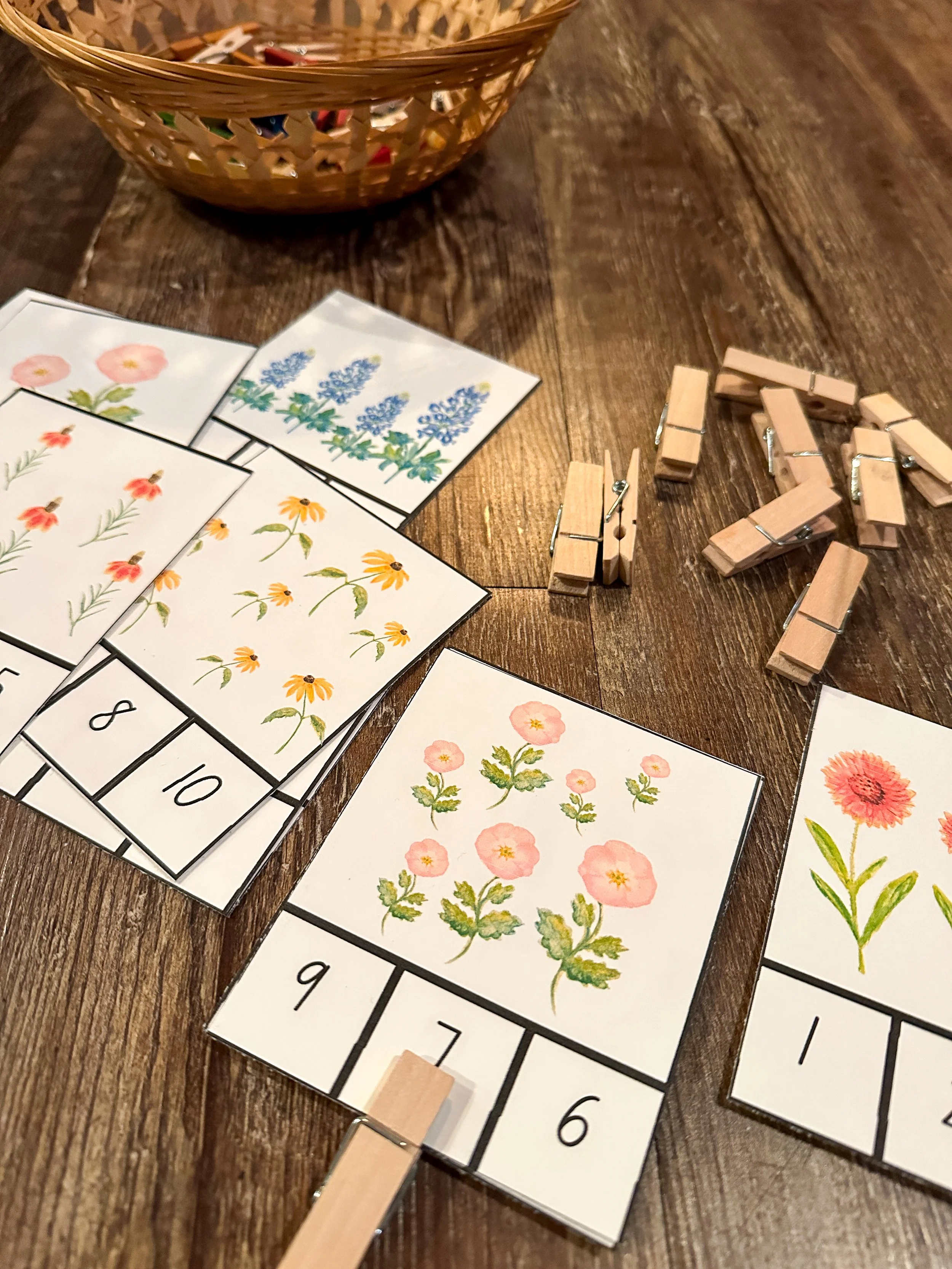
Set up a tray or basket. Montessori-style tray work means everything the child needs is in one place: a small stack of cards and a container of clothespins. The child takes the tray to a table or mat, works through the cards, then returns the tray. This builds routine, organization, and a sense of order.
Start simple. For toddlers (ages 2-3), start with cards that go up to 5. Let them practice the physical motion of clipping before worrying about correct answers. The motor skill itself is the goal at this age. As they get comfortable, introduce the counting element.
Beyond Counting: Other Ways to Use Clothespin Cards
Counting is the most common version, but the clothespin format works for almost any skill:
Color matching. Cards show a colored object; the child clips the matching color name or swatch.
Letter recognition. Cards show a picture; the child clips the correct beginning letter.
Shape identification. Cards show a shape; the child clips the matching name.
Nature identification. Cards show a plant, animal, or flower; the child clips the correct name. This is especially engaging when the cards feature local species that kids can spot on real walks and hikes.
Texas Wildflower Clothespin Cards: Nature Meets Math
We designed our Texas Wildflower Clothespin Cards because we wanted a counting activity that connected math practice to the real world outside our door. Every spring in Texas, roadsides and meadows fill with bluebonnets, Indian paintbrushes, buttercups, and dozens of other native wildflowers. Kids notice them. They pick them (sorry, not the bluebonnets). They ask what they’re called.
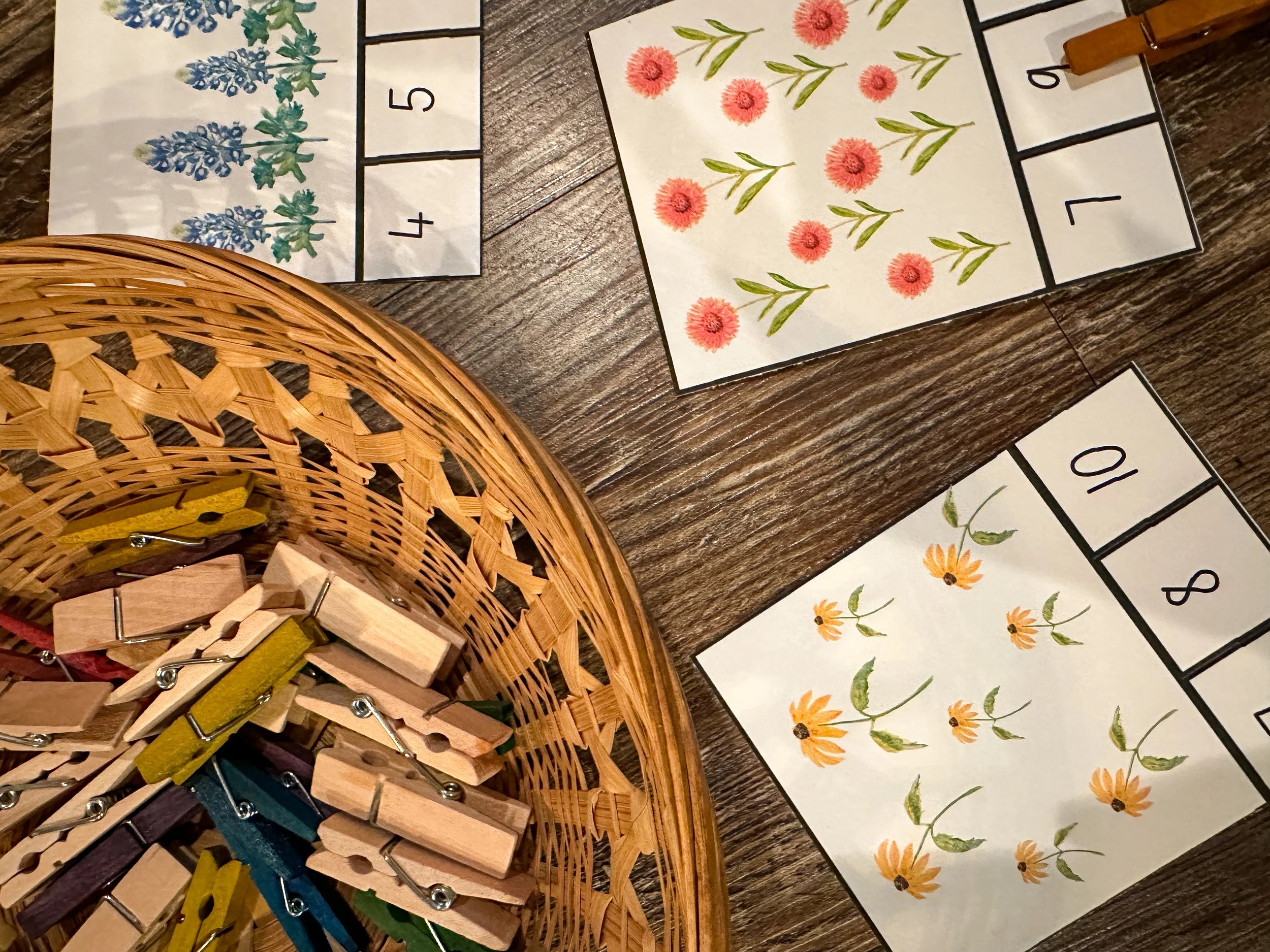
These clothespin cards use original hand-painted watercolor illustrations of Texas native wildflowers as the counting objects. Each card shows a group of wildflowers. The child counts them, then clips the matching number. The cards cover numbers 1 through 10.
What makes these different from the free clip cards you’ll find online: every illustration is original artwork, not clip art. The wildflowers are painted from real botanical references, so kids are actually seeing accurate representations of bluebonnets, Indian blankets, Mexican hats, and the other species in the set. When they spot a pink evening primrose on a walk, they’ll recognize it from their cards.
The set pairs naturally with our Texas Wildflower 3-Part Cards for a full Texas nature study that covers math, reading, science, and fine motor skills in one theme. Use the clothespin cards for counting practice and hand strengthening, then switch to the 3-part cards for species identification and vocabulary building.
Pumpkin Clothespin Cards: Counting Through the Patch
For fall, we also created Pumpkin Clothespin Cards with the same count-and-clip format. This set covers numbers 1 through 12, so it’s a natural next step for kids who’ve mastered counting to 10 with the wildflower set. Four hand-painted pumpkin varieties keep the cards visually interesting: classic orange, sage green, cream, and textured green gourds.
The two sets pair well together. Start with wildflowers in spring and summer, switch to pumpkins for fall, and your child has year-round counting practice with seasonal themes they can connect to what’s actually happening outside.
Texas Wildflower Clothespin Cards | Hand-Painted Watercolor | Numbers 1-10 | Ages 2-6
Count and clip your way through a Texas wildflower meadow. 10 clothespin counting cards featuring original watercolor illustrations of 6 native Texas wildflower species. Print, grab some clothespins, and let your little one build number sense and hand strength at the same time.
Includes: 10 counting cards (numbers 1-10), title card, instruction card Format: Instant digital download PDF, 3 printable pages Species featured: Bluebonnet, Indian Blanket, Pink Evening Primrose, Mexican Hat, Black-eyed Susan, Indian Paintbrush
Count and Clip Through a Texas Wildflower Meadow
These clothespin counting cards turn math practice into a nature connection. Each card features original hand-painted watercolor illustrations of real Texas native wildflowers. Your child counts the flowers, finds the matching number, and clips a clothespin to their answer.
That simple pinch-and-clip action builds the exact hand muscles kids need for writing, cutting, and buttoning. Meanwhile, they're learning number recognition, one-to-one correspondence, and gaining familiarity with the wildflowers growing right outside your door.
What's Inside
10 counting cards covering numbers 1 through 10, plus a title card and instruction card. Six native Texas wildflower species appear across the set: Bluebonnet, Indian Blanket (Firewheel), Pink Evening Primrose, Mexican Hat, Black-eyed Susan, and Indian Paintbrush.
Every illustration is painted from real botanical references, not generated or sourced from clip art libraries. When your child spots a Pink Evening Primrose on a spring walk, they'll recognize it from their cards.
How to Use
Print the PDF on cardstock (65 lb or heavier recommended). Cut the cards apart. Grab a handful of spring-loaded wooden clothespins. Your child counts the wildflowers in the illustration, then clips the clothespin to the correct number along the edge of the card.
For toddlers (ages 2-3): Start with the lower numbers and let them focus on the clipping motion itself. The fine motor workout is the real goal at this age. For preschoolers and kindergartners: Use the full set and encourage them to self-check by counting again after clipping.
Perfect For
Montessori tray work, homeschool morning baskets, preschool math centers, occupational therapy fine motor practice, quiet time activities, and travel (toss the cards and a few clothespins in a zip bag).
Pairs With
Our
Texas Wildflower 3-Part Cards
for a fun Texas nature study covering math, reading, science, and fine motor skills in one theme.
Details
Ages: 2-6
Numbers: 1-10
Pages: 3 (PDF, instant download)
Printing: Unlimited copies for personal or classroom use

Digital download. No product will be shipped.

Download is a high-quality PDF ready to print. Color print recommended. Some files arrive zipped — right-click (or use your Files app) to unzip/extract.

No refunds on digital downloads. If you have trouble with your order or download, contact support@lizadorabooks.com.

Featuring original artwork by Liza Dora. Materials may not be duplicated, distributed, or sold without express written permission from Liza Dora Books. Licensed for personal / household or single-classroom use (including one daycare group). For multi-classroom, school-wide, or district licensing, see /schools or email schools@lizadorabooks.com.Tips for Getting the Most Out of Clothespin Cards
Rotate your sets. Kids lose interest when the same cards sit out for weeks. Swap themes every week or two. Nature themes work especially well because you can match them to what’s blooming or happening outside.
Pair with real objects. After counting wildflowers on the cards, go outside and count real ones. After clipping the number 6, find 6 rocks in the yard. Connecting printed activities to the physical world deepens learning.
Let them be “wrong.” Especially with toddlers, the motor practice matters more than correct answers. If a two-year-old clips to the wrong number but successfully opens and closes the pin, that’s a win. Accuracy comes with time.
Use them as a calm-down activity. The repetitive pinch-count-clip rhythm is genuinely soothing for some kids. Clothespin cards work well as a quiet transition activity between louder parts of the day.
Store in a zip bag with the clothespins. This keeps everything together and makes the activity grab-and-go. Label the bag with the theme and number range so you can find the right set quickly.
More Hands-On Learning
If your kids love the count-and-clip format, check out our other nature-themed printables:
Pumpkin Clothespin Cards (numbers 1-12, ages 2-6): Fall-themed counting and fine motor practice with hand-painted pumpkin illustrations
Nature Counting Cards Bundle (3 sets, ages 3-6): Wildflowers, acorns, and pumpkin seeds for hands-on math with loose parts
Texas Wildflower 3-Part Cards (8 native species, ages 3-12): Montessori nomenclature cards with hand-painted botanical illustrations
Moon Unit Early Learning Bundle (18 activities, ages 2-6): Moon phases, lunar tracking, and a STEM orbits project
Every product features original watercolor artwork, instant digital download, and unlimited printing.