How To Use Montessori Inspired 3 Part Cards
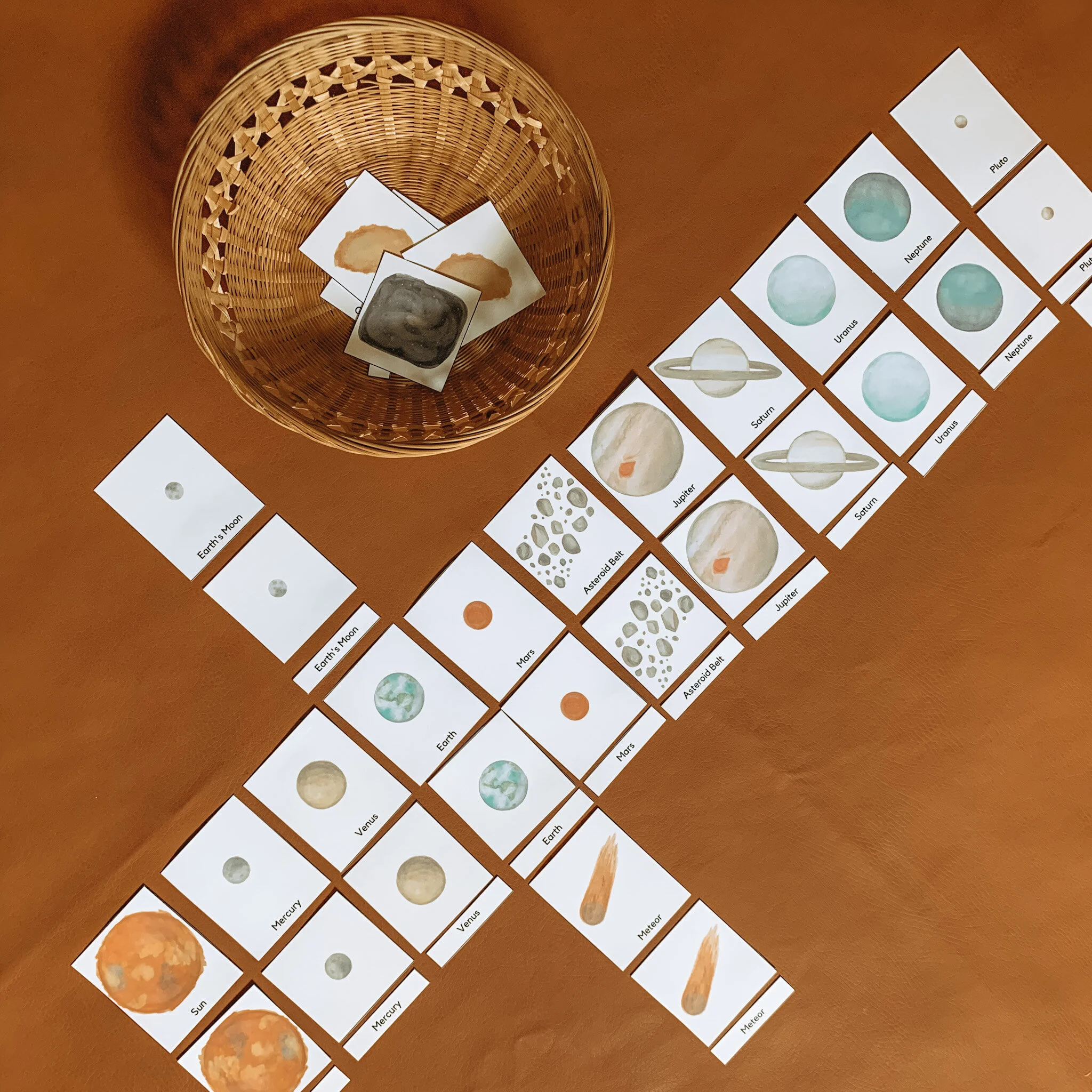
What Are Montessori 3-Part Cards?
Montessori 3-part cards (also called nomenclature cards) are one of the most versatile tools in early childhood education. Each set contains three types of cards:
A key card with both a picture and a label
A picture card with only the image
A label card with only the word
The idea is simple but powerful. Children use the key card as a reference to match the picture and label cards together. This process of sorting, matching, and self-checking builds vocabulary, strengthens visual discrimination, and develops independent learning habits, all at the same time.
Because children physically handle and arrange the cards, they internalize information more effectively than they would through worksheets or screens alone. That tactile, hands-on element is what makes 3-part cards a staple in Montessori classrooms and homeschool spaces.
Best for ages 3 to 6. For elementary students (ages 6 to 9), look for sets that include definition cards instead of picture cards for a more advanced vocabulary challenge.
Why 3-Part Cards Work So Well
Before we get into the activities, it helps to understand why this format is so effective:
Self-correcting. The key card lets children check their own work without waiting for an adult. This builds confidence and supports concentration.
Multi-sensory. Picking up, placing, and rearranging cards engages fine motor skills alongside language and memory.
Adaptable. A single set of cards can be used in half a dozen ways (keep reading for all six). That means one $3 to $5 printable set can fuel weeks of learning.
Cross-curricular. Depending on the subject, 3-part cards cover science vocabulary, math concepts, reading skills, and more. We make sets that cover everything from solar system planets to Texas wildflowers to bluebonnet anatomy.
6 Ways to Use Montessori 3-Part Cards
1. The Traditional Method
This is the classic Montessori approach, and the best place to start if your child is new to 3-part cards.
How it works: Lay out the key cards in a row. Then hand your child the picture cards and ask them to place each one below the matching key card. Once all the pictures are matched, introduce the label cards and have them match those too.
Why it works: The key cards act as a built-in answer key. Your child can glance up to check their work at any time, which means they can do this activity independently once they understand the process.
Tip: Start with just 3 to 4 cards from the set before introducing the full group. This keeps the activity manageable for younger learners (ages 3 to 4).
2. Object Replace
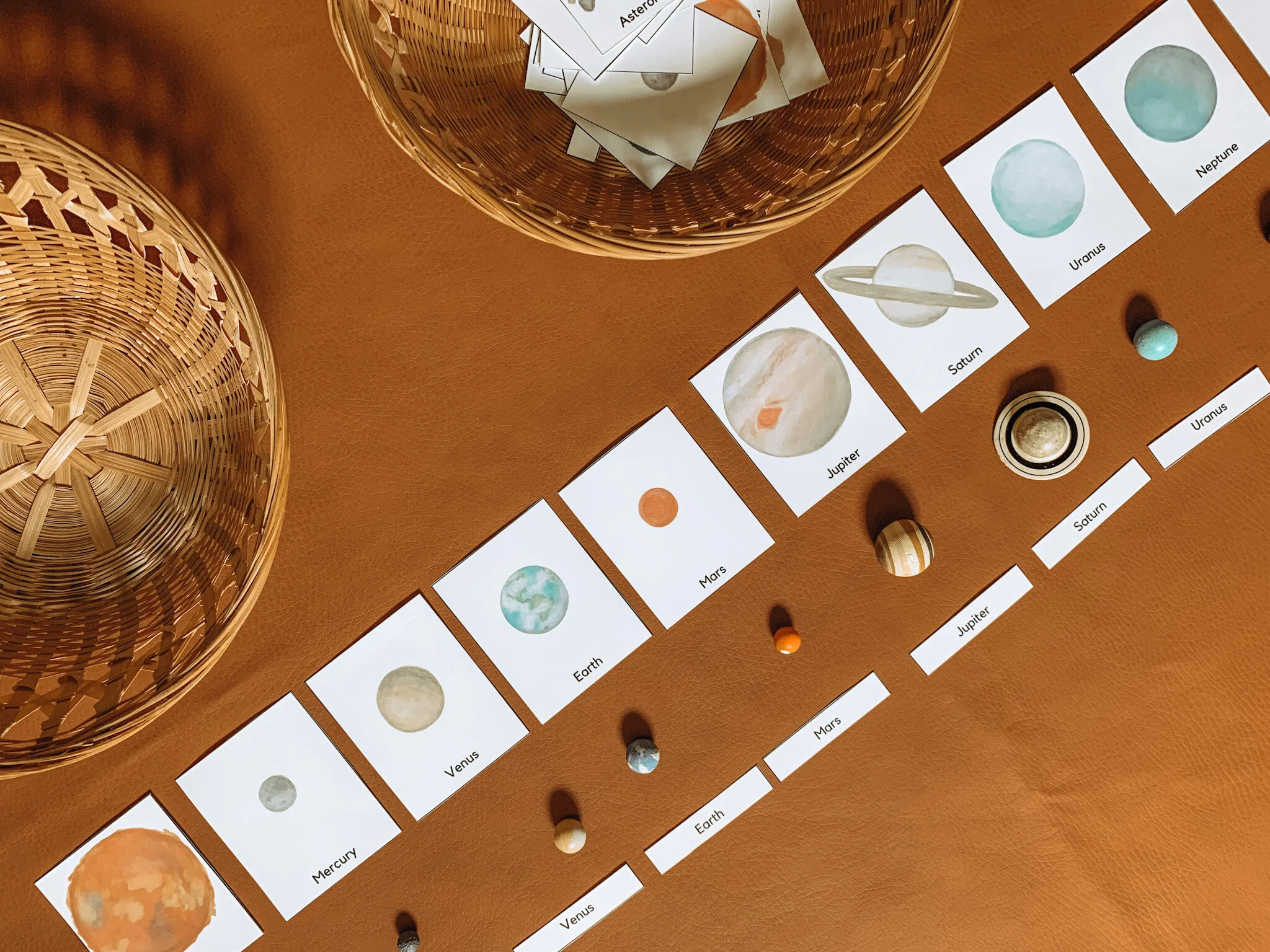
Swap the picture cards for real objects. This is a favorite in our house because it brings the cards to life. In the next example, the student has replaced the picture cards with objects. The object in the example are the Safari Ltd. Solar System items (affiliate). We’ve added our own clay dwarf planet Pluto to the mix for both discussion purposes and nostalgia. (Hey, if they can bring Full House back, I can bring back Pluto.)
How it works: Set out the key cards, then replace the picture cards with miniature objects or natural items that match. For a solar system set, we use Safari Ltd. planet figurines. For a nature set, you could use leaves, flowers, or seeds from your yard.
Why it works: Matching a 3D object to a 2D image and a printed word creates a richer learning experience. It strengthens the connection between the real world and abstract representation, which is a core Montessori principle.
Tip: Safari Ltd. TOOB sets are perfect companions for 3-part cards. The Solar System TOOB pairs beautifully with our Solar System 3-Part Cards.
3. Number Recognition
Use the numbered order of your key cards to introduce or reinforce number recognition.
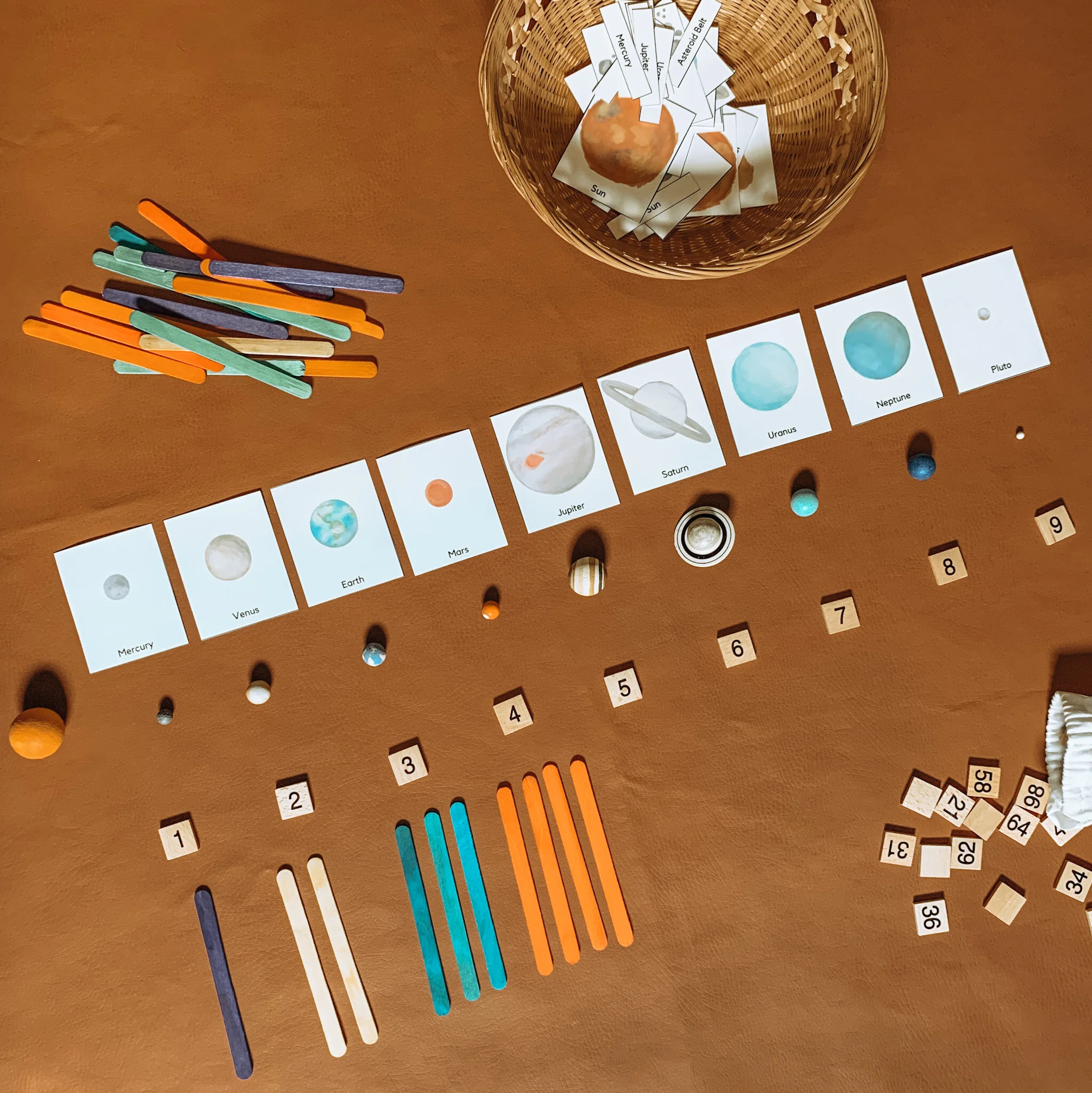
How it works: Many 3-part card sets include a natural sequence (planets in order from the sun, phases of the moon, life cycle stages). Place wooden number tiles or magnetic numbers next to each key card to show its position in the sequence.
Why it works: Children connect the abstract idea of a number to a concrete position in a series. This is especially effective with sets like our Nature Counting Cards, which are designed specifically for number-to-quantity matching.
Tip: Wooden number tiles from a Montessori math set work great here. You can also write numbers on small stones or craft sticks.
4. Counting Practice
Pair your 3-part cards with small counting objects for a math-focused lesson. In the Solar System 3 Part Card example, the numbered order of planets is explored using wooden tiles from our hundred board (affiliate). You could use any number activity you have on hand or even make your own number cards. Your child could also practice writing the numbers themselves.
How it works: Set out the key cards and place a corresponding number of small objects (felt balls, pom-poms, glass gems, dried beans) next to each card. For example, card #1 gets 1 object, card #5 gets 5 objects.
Why it works: This connects quantity to number in a tangible way. Children are not just reciting numbers; they are building them with their hands. It also introduces early addition concepts ("If Mercury has 1 and Venus has 2, how many altogether?").
Tip: Use a muffin tin or ice cube tray to keep counting objects organized. If you want a set designed specifically for this, check out our Nature Counting Cards Bundle, which includes Texas wildflowers, acorns, and pumpkin seeds, perfect for pairing with loose parts.
5. Spelling Practice
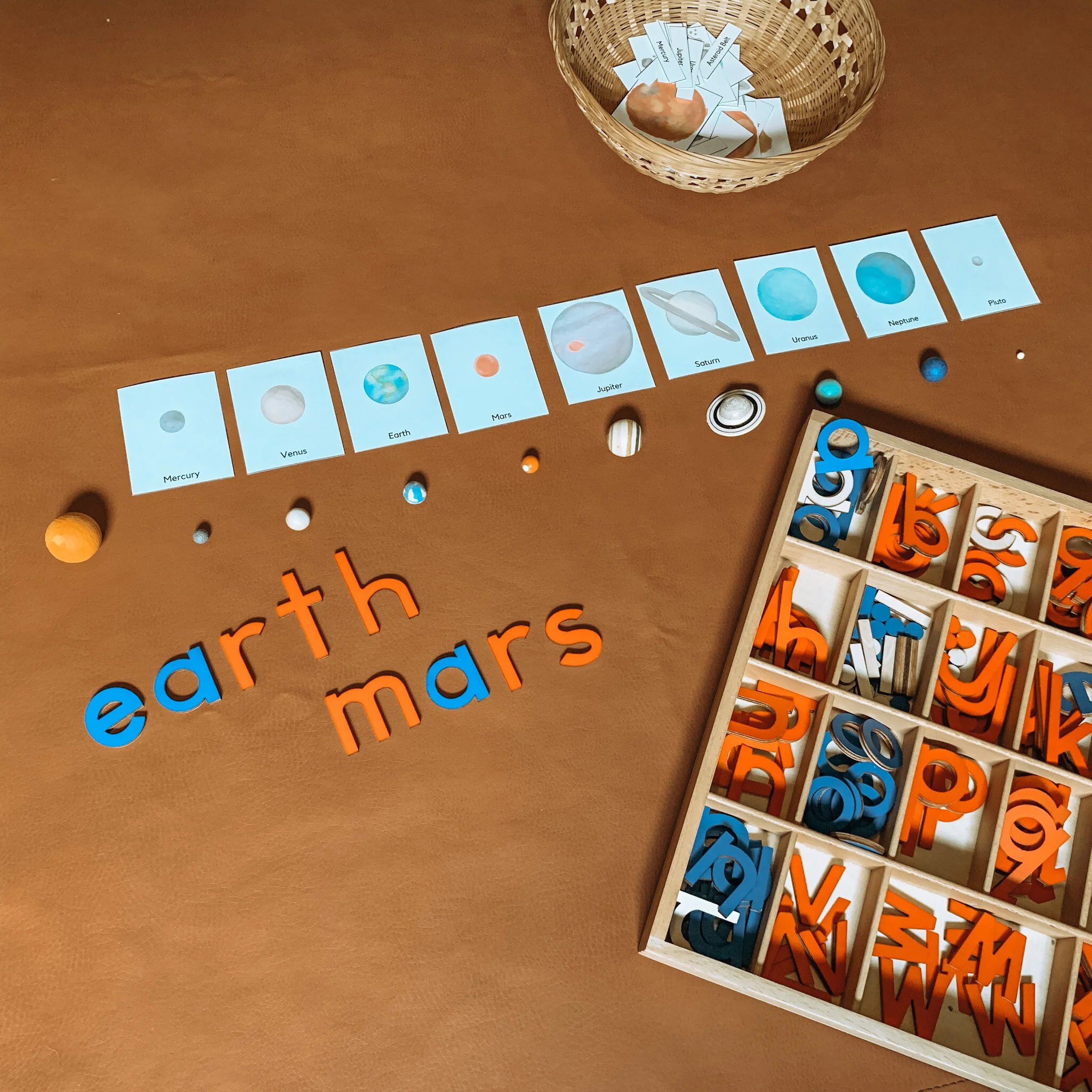
Turn your label cards into a spelling activity using a moveable alphabet.
How it works: Remove the label cards from the set. Show your child a picture card and ask them to spell the word using letter tiles, magnetic letters, or a Montessori moveable alphabet. They can check their work against the label card when they are done.
Why it works: Spelling with physical letters reinforces phonemic awareness and letter formation without the pressure of handwriting. The picture card gives context, and the label card provides built-in self-correction.
Tip: For early spellers (ages 4 to 5), start with 3- and 4-letter words. For more advanced learners, try our Bluebonnet Anatomy 3-Part Cards or Texas Wildflower cards, which include longer vocabulary words like "pistil" and "Indian Paintbrush."
6. "Starts With" Sound Matching
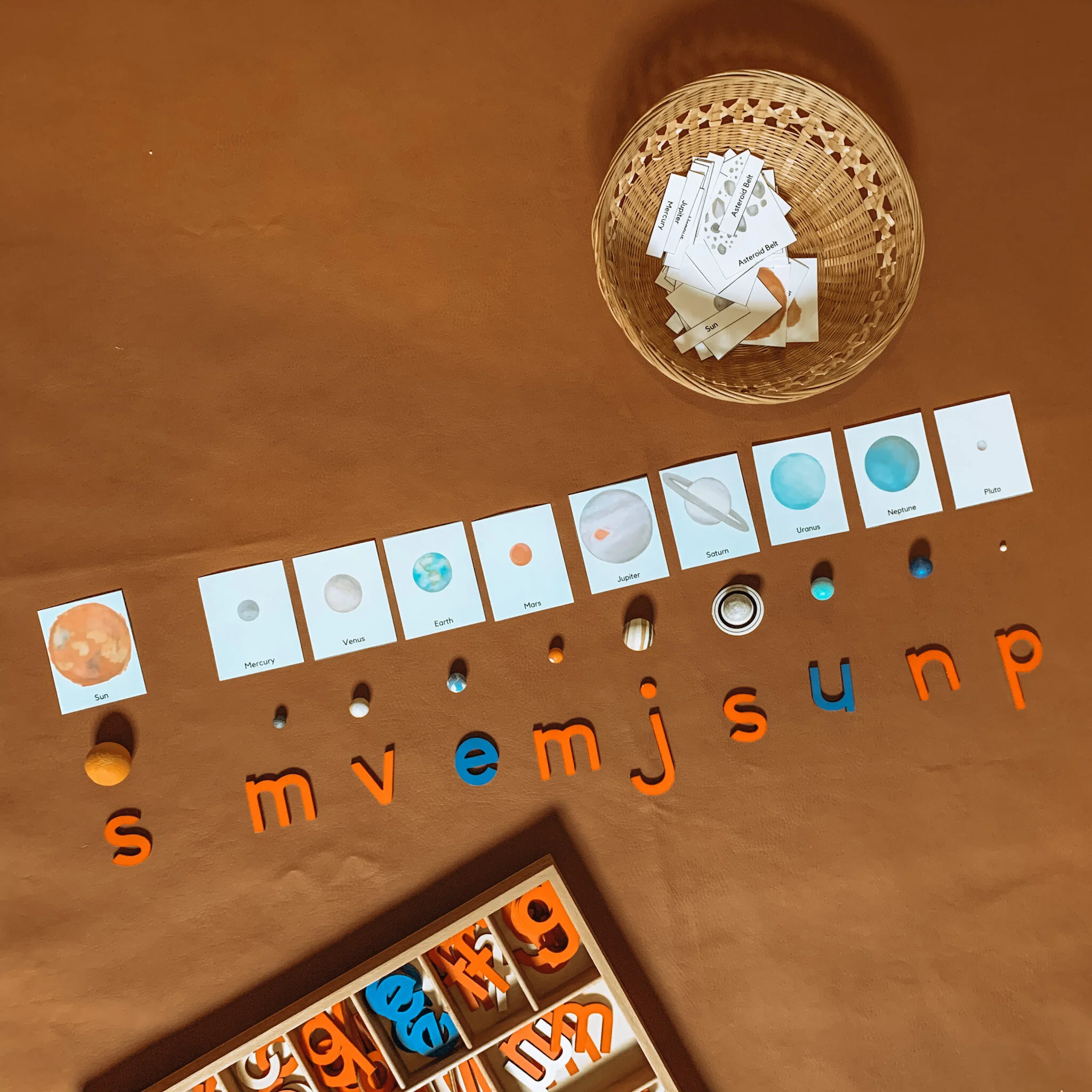
This activity focuses on beginning letter sounds, making it perfect for pre-readers. We use the key cards and/or their objects as language objects. If the sounds aren’t a great match we just use the cards as an opportunity to match first letters. Mmm…Mars works perfectly. Eee…Earth —> not so great. You could always pull out the offending letter sounds and just leave the appropriate ones. Letters are from our wooden moveable alphabet (affiliate).
How it works: Lay out a few picture cards. Ask your child, "What sound does this start with?" or place letter tiles on the table and have them sort pictures by their beginning sound.
Why it works: Isolating beginning sounds is one of the first steps in learning to read. Using picture cards makes it concrete and visual, rather than abstract.
Tip: Start with sounds that are distinct from each other (like M, S, and P) before introducing similar-sounding pairs (like B and D).
Getting the Most Out of Your 3-Part Cards
A few practical notes to help you set up for success:
Laminate for durability. If you are printing at home, laminating your cards (or using self-adhesive laminating sheets) will make them last through years of use. This is especially important for the object replace and counting activities, where little hands are busy.
Store in labeled envelopes or bags. A small zip bag or manila envelope for each set keeps cards organized and makes it easy to grab a set for a quick lesson.
Rotate sets. Rather than putting out every set you own, rotate 2 to 3 sets at a time on your child's shelf. This keeps the activity fresh and prevents overwhelm.
Pair with a tray. In Montessori, activities are typically presented on a tray. This gives the child a defined workspace and makes cleanup straightforward.
Ready to Try 3-Part Cards?
All of our 3-part card sets feature original, hand-painted watercolor artwork, not clip art. Each set is designed as a printable PDF that you can download and use the same day.
Browse our current sets:
Solar System 3-Part Cards ($3.00)
Texas Wildflowers 3-Part Cards ($5.00)
Bluebonnet Anatomy 3-Part Cards ($3.00)
Looking for bundles with 3-part cards plus additional activities? Try our Fall Early Learning Bundle, Moon Unit, or Bluebonnet Anatomy Mini Unit.
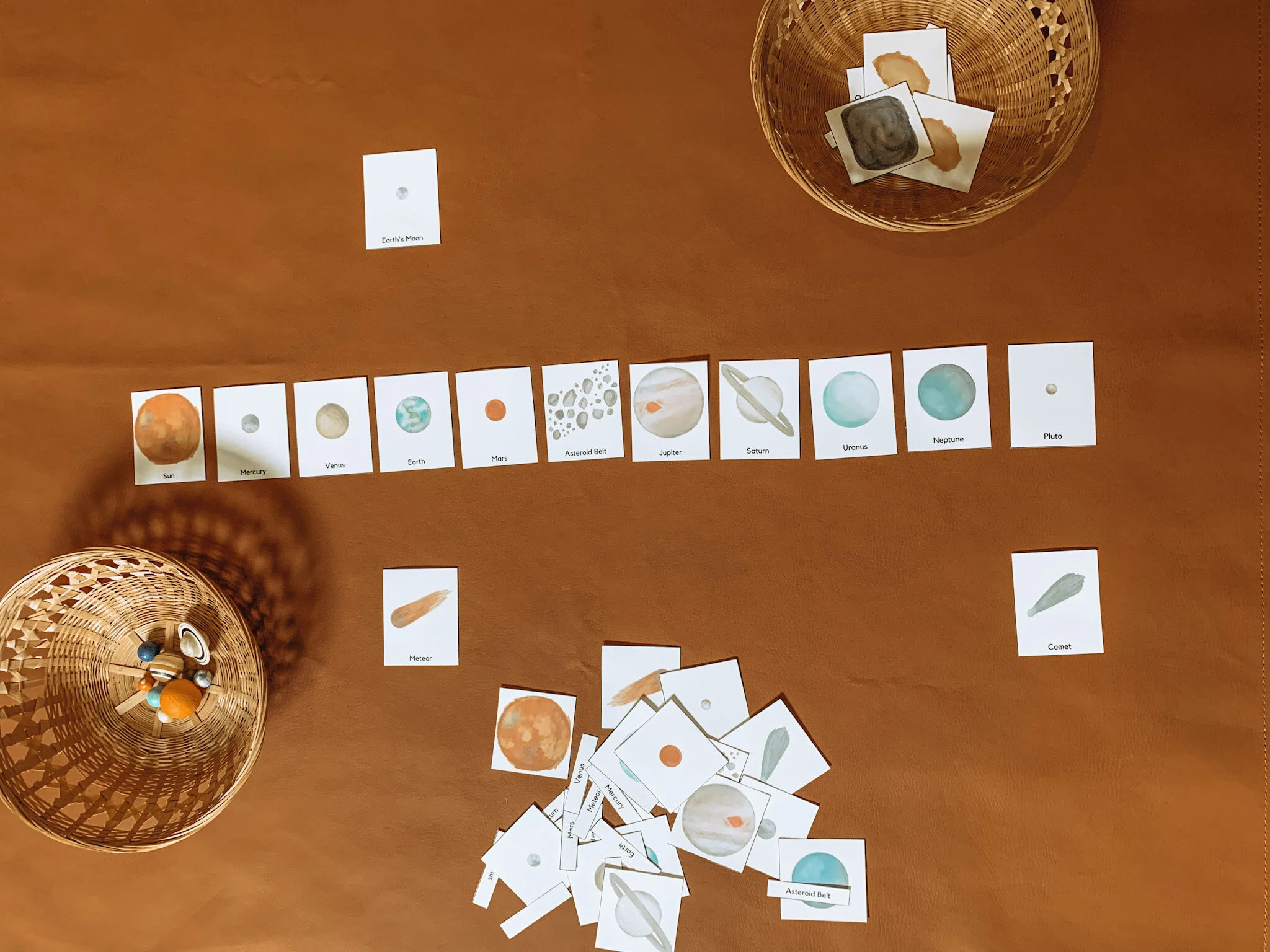
I hope you found this short guide and list of ideas on using Montessori Inspired 3 Part Cards helpful and informative. Links presented in this post may be affiliate links, but I only link to products I know and use in our home.
Thanks for reading!
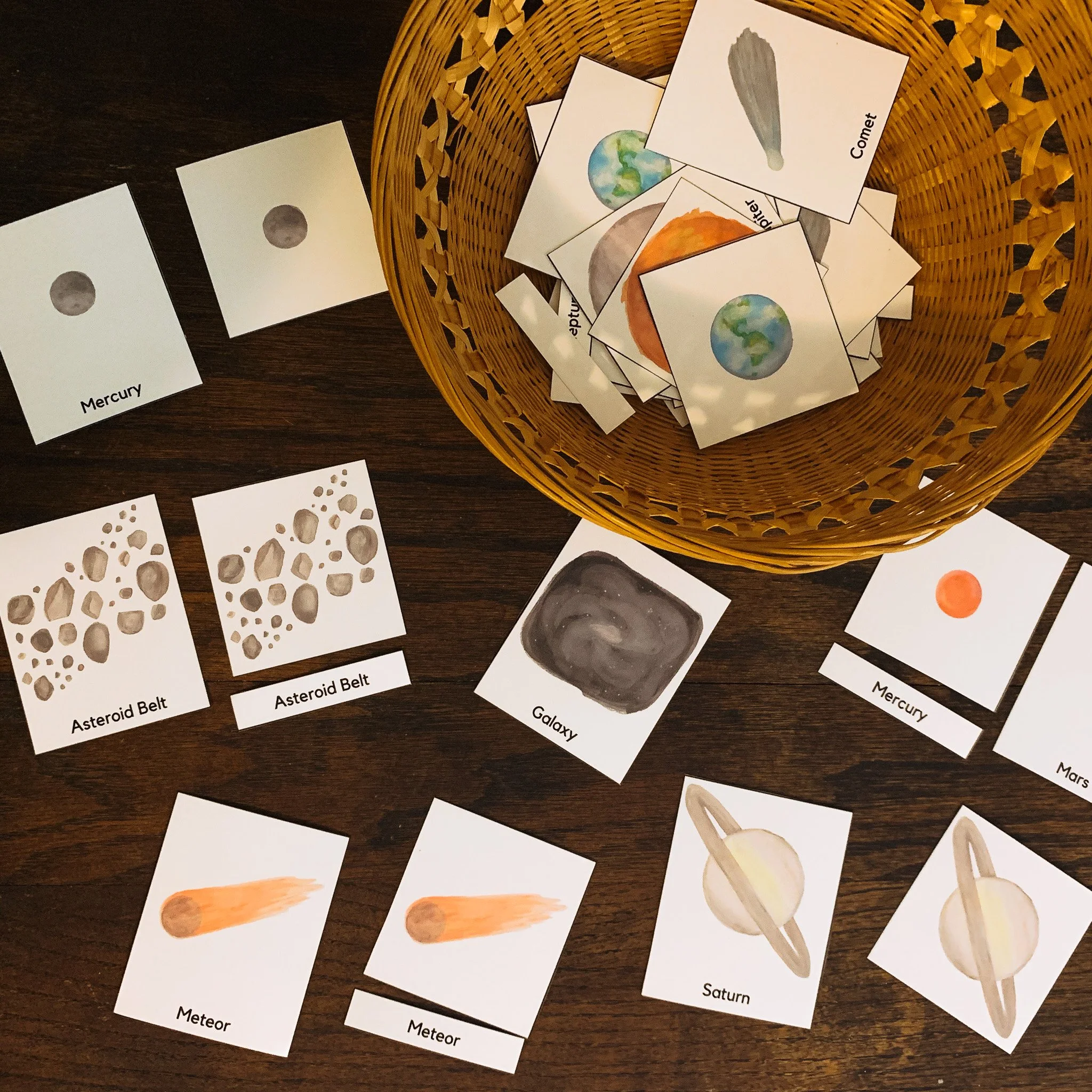
Blast off into the solar system with 16 hand-painted watercolor 3-part cards! This set covers all 8 planets, the Sun, Earth's Moon, Pluto, and five more celestial bodies your child will love discovering. Every illustration is original watercolor artwork, not clip art.
🪐 16 Watercolor Cards
Sun, Mercury, Venus, Earth, Mars, Jupiter, Saturn, Uranus, Neptune, Pluto
Earth's Moon, Asteroid Belt, Meteor, Comet, Star, Galaxy
🔬 5 Built-In Activity Extensions
Classic 3-Part Card Work:
Lay out picture cards, match the labels, then remove the control cards for independent practice
Order from the Sun:
Sequence the planets outward. Pair with a mnemonic device or moveable alphabet for spelling reinforcement
Counting and Math:
Line up planet cards in order and place number tiles (1 through 8) beneath each one. Count out craft sticks or beads to match
Sort and Classify:
Spread all 16 cards and sort into groups: planets, dwarf planets, things that orbit, things that don't. Is Pluto a planet or something else? The conversation matters more than the categories
Add Manipulatives:
Pair the cards with small marbles, painted wooden beads, or planet models. The more your child can hold, move, and arrange, the deeper the learning goes
📐 3 Age Tiers
Ages 4-5:
Start with the planets and the Sun. Save the Asteroid Belt, Meteor, Comet, Star, and Galaxy cards for later
Ages 6-8:
Use all 16 cards. Introduce sorting by type and the counting extension with numbered tiles and craft sticks
Ages 9-12:
Use the cards as a launchpad for research. Look up planet sizes, distances, and number of moons. Explore why Pluto was reclassified or what the Asteroid Belt actually looks like
What makes these 3-part cards special:
🎨 Original hand-painted watercolor artwork on every card
🌍 Goes beyond the 8 planets: includes the Asteroid Belt, Meteor, Comet, Star, Galaxy, and Pluto
🧠 Five different ways to use one set of cards, from simple matching to full research projects
🔢 Built-in math connection: turn the solar system into a concrete number line
💬 The sort-and-classify activity is a conversation starter, not a worksheet. There's no single right answer, and that's the point
Perfect for:
Montessori homeschool families, preschool and elementary classrooms, science centers, morning work rotations, homeschool co-op activities, and space-obsessed kids of all ages. Print on cardstock and laminate for cards that hold up through hundreds of uses. Line them up on the table, pair them with marbles or planet models, and watch your child build the solar system from memory!
How It Works:
Purchase and download instantly
Print the picture cards, label cards, and control cards on cardstock (color print recommended). Laminate for durability
Lay out the planets, grab some loose parts, and start exploring the solar system!
No shipping wait. No subscription. Just download, print, and explore!
Pairs With:
Solar System Counting Puzzles ($5)
for number sense from 1 to 99 plus skip counting by 2s, 5s, and 10s, using the same watercolor planets
Nature Counting Cards ($5)
for hands-on math with Texas Wildflowers, Acorns, and Pumpkin Seeds

Digital download. No product will be shipped.

Download is a high-quality PDF ready to print. Color print recommended. Some files arrive zipped — right-click (or use your Files app) to unzip/extract.

No refunds on digital downloads. If you have trouble with your order or download, contact support@lizadorabooks.com.

Featuring original artwork by Liza Dora. Materials may not be duplicated, distributed, or sold without express written permission from Liza Dora Books. Licensed for personal / household or single-classroom use (including one daycare group). For multi-classroom, school-wide, or district licensing, see /schools or email schools@lizadorabooks.com.